If we stop obsessing about economic growth and focus directly on our social aims then economic growth will take care of itself, writes economist Warwick Smith.
WHY ARE WE so consumed by the pursuit of economic growth?
Malcolm Turnbull made the economy the primary focus of both his pitch for leadership of the Liberal party and his victory speech. It was a smart move because, under Abbott and Hockey, almost everyone was questioning that age-old belief that the Coalition are the better economic managers.
Economic measures have become the principal indicators of success or failure of governments. They shouldn’t be, but they are.
Economic theory holds growth to be desirable for two major reasons. The first is that the more money an individual has, the more of their preferences they can satisfy; that is, they can get more of what they want. This preference satisfaction is the very definition of human welfare, according to economic theory.
The second reason that economic theory holds growth to be desirable is employment. Almost any increase in efficiency must be accompanied by economic growth if employment levels are to be maintained. To take an example: supermarkets will eventually have no staff at checkouts, either through technology that automatically registers all items or, as is already happening, by passing the cost over to the customer in self-service aisles. The supermarket saves money and can increase profits and discount prices. If checkout staff find alternative work without displacing other workers, the economy grows because more work is being done than before.
Similarly, if we have net migration above zero – more people coming into the country than leaving it – then we need a growing economy in order to provide them all with jobs.
So, economic growth creates jobs — most of the time.
The problem with both of the above justifications for the pursuit of economic growth (preference satisfaction and employment) is that they are indirect ways to achieve their stated goals.
Economic growth is a worthy pursuit for Turnbull, but he won’t be able to ignore inequality | Mike Steketee http://t.co/0nSsRz9yvr
Preference satisfaction is a very crass and imperfect proxy for human welfare. While there’s no doubt that those in extreme poverty benefit enormously from additional wealth, the effect diminishes as we get wealthier. Research has shown that you pretty much have the same impact on any person’s self-reported wellbeing by doubling their income. In other words, you can get the same increase in overall wellbeing by spending $20,000 to double the income of a poor person (in Australia), or $200,000 doubling the income of a wealthy person.
If human welfare is our main concern, then it’s clear from the data that, in wealthy countries, the distribution of wealth and income is far more important than simple measures of overall economic growth. It’s possible for the economy to grow while income and wealth at the bottom of the distribution stagnates or even declines. Since the financial crisis in 2008, a staggering 95% of income growth in the United States has gone to the top 1% of income earners. A growing economy but a stagnating middle and lower class.
Similarly, if employment is a major concern, then employment should be directly targeted rather than assuming that economic growth will take care of it. In the post-war period of the 20th century most developed nations had full employment policies. Australia’s unemployment through the 1950s and 60’s averaged about 2%. Economic reforms in the 1970s and 80s that are credited with fostering 25 years of uninterrupted economic growth also lifted what we viewed as an acceptable level of unemployment to around 5% and actual unemployment often significantly higher than that.
It is important that we understand that this is a policy choice. If we so chose to, we could return to an unemployment rate of 2%. There are many paths to full employment including a full-blown job guarantee policy. Under such a scheme the Federal Government could act as employer of last resort. In other words they would give a job – at or maybe just below the minimum wage – to anyone who wanted one. The impact would be not only to eliminate involuntary unemployment, but also to make the economy more robust and flatten out the boom and bust of the business cycle.
We know a job guarantee could work and it would be much more effective than just targeting growth and then crossing our fingers.
Our manic obsession with never-ending economic growth is driving our planet to ruin, writes Dr Adnan Al-Daini. #GDPhttps://t.co/LQiuu3Z6Pv
So, where does this leave us with respect to public policy priorities? The simple reality is that if we stop obsessing about economic growth and focus directly on our social aims then economic growth would take care of itself. High levels of inequality reduce economic growth. High levels of unemployment, particularly long-term unemployment, reduce economic growth. Climate change, if not addressed, will cause massive economic damage.
Let the private sector obsess over growth if that’s what they want. The public sector should focus on the public.
Warwick Smith is a research economist at the University of Melbourne. He will be running a workshop discussing these issues and more at the Local Lives Global Matters conference in Castlemaine, Victoria, from 16 to 18 October. You can follow Warwick on Twitter @recoeco.
It would be a mistake to write off the new Prime Minister’s climate change policy ambitions at this early stage. With global momentum building, the situation could look very different after the next election, writes Warwick Smith.
China’s announcement that it will implement a nationwide emissions trading scheme in 2017 is globally significant, but it also shifts the power balance in Australia’s climate policy chess game.
For Turnbull, and others in the Federal Government who take the threat of climate change seriously, this is not about convincing the climate naysayers in the Coalition of the merits of more meaningful action; it’s about working towards checkmate where all of their reasons against action are undermined and they have no more publicly defensible arguments.
The inaction of the US and China, the world’s largest emitters of greenhouse gases, has long been one of the key excuses for inaction in Australia. The argument has been repeatedly made that if China and the US are not taking action, then it’s pointless for us to do so.
That excuse is clearly no longer credible – if it ever was.
Here’s what Greg Hunt, then opposition environment spokesman, had to say in April 2013:
Where a real global agreement will come is when China and United States reach a point of common position and when that’s backed up with India and the EU.
Ongoing joint announcements by China and the US on their climate policy pledges are representative of international momentum that is steadily building towards the critical Paris climate conference in December.
Leading the way, Sweden has just announced plans that it says will set it on the path to become the first fossil fuel free nation. The likelihood of a meaningful agreement being reached in Paris is growing by the day. Both explicit and implicit pressure is building on Australia to come to the negotiating table with more ambitious emission reduction targets.
Despite this building pressure, Malcolm Turnbull has recommitted the Coalition to the emission reduction target announced by Tony Abbott (26-28 per cent reduction on 2005 levels by 2030) and has signed an agreement with the Nationals that there will be no change to Coalition policy on climate change.
Many think Turnbull has sold his soul to the right of the Coalition in order to become Prime Minister. However, Turnbull’s ego and self-confidence should not be underestimated, and it would be a mistake to write off his policy ambitions at this early stage. That said, in order to pursue his own climate policy goals, he has to play a highly nuanced game.
Turnbull must stick to his agreements with the right of his own party and with the Nationals in order to create the stability needed to win the next election, but he also needs to give signals of his intention to change policy if he’s to avoid the accusation of acting without a mandate. He currently appears to be putting the Coalition into something of a policy holding pattern in the short to medium term, placing pressure on Bill Shorten to lift his game in response to flagging support for Labor in the polls.
After the next election, if the Coalition wins, all bets will be off and the agreement between the Liberal and National parties will be renegotiated. After an election win, Turnbull will be in a much stronger position to push his own agenda both within the Liberal party and with his Coalition partners.
It is in this context that we should view Environment Minister Greg Hunt’s recent comments regarding the possibility of strengthening Australia’s targets during future reviews the Paris agreement. This doesn’t break promises made to the Nationals (though it will certainly make them nervous) but it signals to the electorate that the current weak targets are not locked in for the long term. Comments like these create the escape hatch against future accusations of backflips or broken promises.
Despite what he may be saying publicly, we know that the Prime Minister thinks the direct action climate policy is inadequate. He’s stated openly and plainly on more than one occasion that putting a price on carbon is the only way to achieve the kind of deep cuts that are needed to avoid the worst impacts of climate change. Watching him walk the tightrope between the promises he had to make in order to become Prime Minister and his own personal views will likely be one of the more interesting political spectacles of the coming year.
Originally published by The Age on September 3, 2015 – 12:17PM.
Talk of throwing Hockey to the wolves is worrying. After all, it’s his slip-of-the-truth lines that give us a glimpse of the Government’s real agenda: only the rich and powerful matter.
Treasurer Joe Hockey addressed the CEDA conference at Parliament House in Canberra on Monday 22 June 2015. Photo: Andrew Meares
In a political system based on spin and obfuscation, clarity and honesty are rare indeed. This is why recent talk of throwing Joe Hockey to the wolves is worrying. When Hockey tells Sydneysiders to get a good, well-paying and secure job if they want to enter the property market, he is telling us what this government really thinks. If you don’t have a job that pays much better than the average wage then you don’t deserve to own your own home. If the best you can do with your life is be a teacher in a public school or a nurse or a waiter then you’re not worthy of his concern or interest. Get a better job, then come talk about your problems.
Hockey’s unscripted moments of truth and clarity combine with his budget measures to leave us with no doubt that looking after those with wealth and privilege at the expense of those without is the overarching guiding principle of this government. Of course, he would have his own internal justification for this stance that would sound a lot less aristocratic but if exposed to critical scrutiny it would be unlikely to hold water. This, of course, is why such views are not exposed to public scrutiny except in those lovely moments when Hockey has a slip-of-the-truth.
“What [Hockey] really thinks is that those who can’t afford to buy a house don’t deserve to have one.”
Hockey represents those who don’t need to even think about housing affordability. He knows lots of people who are buying in Sydney. He knows lots of people who own lots of houses in Sydney. ‘How can it be unaffordable if people are affording it?’ he earnestly asks.
Treasurer Joe Hockey’s great value is that occasionally he slips up and accidentally tells the truth. Photo: Alex Ellinghausen
There are two kinds of people in Hockey’s world; the ‘lifters’ who have money and power and the ‘leaners’ whose primary role is to provide the goods and services to those with money and power. Only the former really matter. If you’re not up to the task of gaining money and power then don’t come knocking on Joe Hockey’s door. By contrast, if you’re wealthy enough to have clever accountants who can funnel your large income through trusts, companies and self-managed superannuation funds then Hockey’s your man in Parliament. He’s keen to cut government expenditure on anything that benefits the ‘leaners’ but massive government tax concessions for the ‘lifters’ are out of bounds in the crusade to balance the budget.
Clearly Hockey is not stupid enough to think that everyone can have an above average salary. Therefore, what he really thinks is that those who can’t afford to buy a house don’t deserve to have one. You’re either part of the wealthy elite or you’re the scum on the bottom of the pond. I wrote about this very attitude in the aftermath of Hockey’s first budget, explaining how Hockey and Abbott want to make Australia more like the United States where being born poor means worse (or no) healthcare, worse education, worse job prospects and worse life outcomes while being rich means paying a lower rate of tax than your secretary.
So, what is Joe Hockey’s internal conversation about wealth and welfare likely to look like? I doubt we need to look any further than the work of Ayn Rand, an author with a cult following among those who run the world. Her books are reverently passed around the halls of world’s elite colleges. The heroes of her novels are people of principle held back by the parasitic masses and the governments who represent them. Rand’s great delusional thesis is that everyone should just get out of the way of great people and let them do their thing. Rupert Murdoch is probably the quintessential real-life Randian hero.
I’d be willing to guarantee that if you could have an honest conversation with slip-of-the-truth Hockey he would admit to being a fan of Ayn Rand, or at the very least agree with her central ideas.
This is a man who would make young job seekers wait six months before receiving any income support while definitively ruling out touching the tens of billions of dollars we hand over every year in tax concessions to the top ten percent of income earners. Maybe you could forgive him somewhat if there were vast numbers of unfilled jobs waiting for applicants but the opposite is true; there are far more job seekers than there are jobs. Joe really wanted to punish young people for not being in one of the non-existent jobs. He knows this is the reality of his proposed measure. Ask yourself what kind of man would want to do that to young job seekers. The same kind of man who thinks poor people don’t drive cars.
Don’t call for them to sack Joe Hockey; his slips-of-the-truth are the only glimpse we get of what this government really thinks.
Warwick is a research economist at the University of Melbourne.
PHOTO: Tony Abbott visits a newly opened Queensland coal mine in 2014. (AAP: Dan Peled)
A larger emissions reduction target would have come at very little additional cost to GDP, but it would have involved the loss of jobs in the high emissions industries that our Prime Minister champions, writes Warwick Smith.
The Government will take this commitment to December’s United Nations climate summit in Paris where post-2020 global targets will be negotiated. This target is among the lowest of any developed country, with even laggard Canada committing to a 30 per cent reduction from 2005 levels.
The barriers to deeper cuts are neither economic nor technical, and it’s abundantly clear that Australia, one of the richest countries in the world, can afford much more substantial cuts to greenhouse gas emissions than the Prime Minister is offering.
The Government has previously committed to targets in line with keeping global temperature increases below 2 degrees Celsius. However, Australia’s Climate Change Authority has calculated that Australia would need cuts of at least 45 per cent on 2005 levels by 2030 if we are to make our fair contribution towards this goal.
The per cent figures can be confusing because different countries are choosing both different reference dates and different target dates. For instance, the US is promising 26 to 28 per cent cuts on 2005 levels but will achieve it by 2025, making it significantly more ambitious than Australia’s 26 to 28 per cent by 2030. The EU have promised to go much further with a 40 per cent cut on 1990 levels by 2030.
Australia already intends to cut emissions by 5 per cent on 2000 levels by 2020. This equates to about a 13 per cent cut on 2005 levels. This means we are only offering an additional 13-15 per cent on top of what will have already been achieved.
There are many paths to such a modest target, the cheapest likely to come from efficiency improvements in the energy sector.
What’s hidden within those small GDP cost figures is that there will be some big losers and big winners. Any genuine effort to keep global temperature increases below 2 degrees will eventually require us to almost entirely stop burning fossil fuels.
While we will see the steady demise of the coal industry, we will also see the emergence of low-emissions alternatives to many products and services. It is this surge in low emissions alternatives that makes it possible for us to achieve substantial emissions reductions with a relatively low national price tag.
Many will lose jobs in high emissions industries, but many jobs will be created in other areas. Such employment transitions have always accompanied technological and social progress. Defending the status quo based on sectoral job losses is to effectively argue against all technological progress.
“The Government’s Direct Action plan for reducing emissions is soundly rejected on efficiency grounds by virtually all economists.”
The economics of emissions reduction is very straightforward. There are a handful of accepted market-based methods to efficiently reduce emissions; from a carbon trading scheme to theCitizen’s Climate Lobby proposal for a carbon tax and dividend (where the proceeds of the tax are divided between all citizens).
By contrast, the Government’s Direct Action plan for reducing emissions is soundly rejected on efficiency grounds by virtually all economists. It’s desirable from a polluter perspective because they get paid for their reductions instead of having to pay for their pollution.
Outside of accepted mainstream options for emissions reductions, there are plenty of more radical options. Our stationary energy production is responsible for around half our greenhouse gas emissions and holds the key to a successful transition to a post-carbon economy. Given the tailing off of the mining construction boom, it would be possible for the Federal Government to employ that spare capacity to build 21st century renewable electricity generation and distribution infrastructure. This would result in dramatic reductions in emissions and would also spark investment in energy-intensive ecologically sustainable industry.
Borrowing costs are at an all-time low and borrowing for such a project would definitely come out favourably in a cost-benefit analysis if climate costs and benefits are included. However, with inflation risk currently very low, and appropriate spare capacity in the economy, it would also be possible to simply create the money necessary for such a project.
We have seen the US Federal Reserve and the European Central Bank create vast sums of money (referred to as quantitative easing) to avert crises in the financial sector. Why not create money to avert a crisis in the atmosphere? I can hear gasps of horror from the financial semi-literate but it’s simply a sign that they don’t understand the reality of post-Bretton Woods monetary economics. If carefully managed to avoid inflation risk, this project could be almost costless and generate substantial economic stimulus.
Options for deeper cuts abound and, given that the Government’s own commissioned economic modelling shows that increasing the target to 35 per cent would cost little extra, it is clear that this low commitment is purely about protecting Tony Abbott’s beloved coal industry at everyone else’s expense.
The sad news for Tony Abbott is that no matter what he does, the coal industry is living on borrowed time. The sooner we understand that in Australia, the sooner we can build new sources of prosperity.
This morning I was talking tax on 2ser‘s breakfast program with Mitch Byatt. We focussed on state finances and today’s tax meeting between state premiers and the Prime Minister. An increase in the GST is on the table but, in the interview, I suggest they should pay heed to a recent Treasury report (that I referred to in my last Conversation article) showing that land taxes are bar far the most economically efficient option for shoring up state finances. Land taxes also don’t require complex and expensive compensation packages that must accompany any increase in the GST.
You can listen to the five minute podcast of the interview here.
Would be first home buyers are being increasingly priced out of the market, particularly in capital cities, and many are resigned to a lifetime of renting.
To say that taxation has a profound effect on investment decisions is to make a gross understatement. In Australia, real estate is very favourably taxed. This results in a skew towards real estate investment that lifts prices. Most investment is in existing housing stock – proof that the resulting impact on supply is minimal.
There are many tax policies that impact on real estate investment and prices but the four most important are negative gearing, the concessional treatment of capital gains, stamp duties and land taxes.
Negative gearing
A negatively geared property loses money with respect to cash flow. The costs (primarily, but not restricted to, interest payments) exceed the income (rent). Negative gearing provisions mean that these losses can be offset against other income.
The fact that negative gearing is so popular should ring alarm bells. Investment properties are operated at a loss only on the assumption that the real return will come from capital gains when the property is sold. In other words, negative gearing is entirely dependent on investors making unearned income (economic rent).
Capital gains are unearned income because the owner of the property does nothing to create the extra value. Buildings depreciate in value over time but land tends to rise in value. This is where capital gains come from, land value increases. Land values increase due to community and government action; including the provision of infrastructure and services and population growth.
No capital gains tax is paid on a primary residence and, for individuals, only half of a capital gain is taxed for investment properties. Capital gains tax is levied at the owner’s marginal tax rate but, because of the concession, the maximum tax on capital gains is 22.5% (half the top marginal tax rate). As a result of negative gearing and the concessional treatment of capital gains real estate is an artificially attractive investment class.
Stamp duties
Stamp duties are state based taxes that are levied at the time of purchase and are based on the sale price. Economists overwhelmingly consider stamp duties to be inefficient and undesirable. The primary reason for this is because they are a barrier to the efficient allocation of housing stock.
The large cost of stamp duties acts as a disincentive for people to move to properties that better suit their needs. The classic example is that of parents remaining in a large family home after their children have left because stamp duties would erode much of the financial benefit of moving to a smaller home.
Stamp duties do, to some extent, discourage investment in real estate. However, this effect is small when compared to the impact of the concessions described above.
Land taxes
There are currently two types of land taxes in all Australian jurisdictions; local government rates and state or territory government land taxes. Both taxes are levied on investment properties but owner-occupied housing is exempt from state and territory land taxes. Land taxes are among the most economically efficient taxes.
A recent report by the Commonwealth Treasury showed that land taxes actually create a net economic benefit whereas all other taxes examined created additional costs in excess of the taxes themselves (referred to as marginal excess burden) with stamp duties being the worst of those examined.
Stamp duties are the least efficient of the taxes examined while land taxes were the most efficient; actually generating net economic benefits instead of losses. Treasury estimates, Author provided
Social justice
The overwhelming majority of tax concessions go to the wealthiest 20% of citizens. Concessions on real estate are no different. Meanwhile, stamp duties create a substantial barrier to lower income Australians purchasing a home while wealthy investors can afford the stamp duties with the expectation that they will be recovered through capital gains.
Not only is the current taxation of real estate economically inefficient and results in artificially high prices, it is also inequitable. State and federal governments have created benefits that substantially favour those with high incomes and wealth and costs that disproportionately disadvantage the rest.
Reform options
A recent Grattan Institute report suggested cash strapped state and territory governments could generate an extra A$7 billion per year by switching from stamp duties to a low rate annual land tax. Not only would this help state governments fill their revenue holes but it would also create a more efficient economy. The ACT is leading the way and is making this transition in slow increments over the next 20 years.
I would go further and suggest that negative gearing should also be abolished and the concession on capital gains tax for real estate should be removed. Land taxes should replace many minor and inefficient state and territory taxes including insurance taxes. Well targeted land taxes could also be used to fund substantial infrastructure investment.
The often stated purpose of concessional taxation of real estate is that it encourages the supply of housing. However, the overwhelming majority of these concessions go to investors who are buying existing housing stock. At the very least these generous concessions should be quarantined to only apply to new housing stock.
The barriers to reforming real estate taxation arrangements are significant. Around two million Australian taxpayers have investment properties and would likely oppose reform. In addition, the imposition of a significant land tax would cause a one-off fall in land prices, potentially leaving some recent buyers with mortgages higher than the value of their properties. In order to make the reform palatable it would have to be either phased in slowly (as the ACT is doing) or grandfathered so that existing investments operate under the old tax provisions.
Serious tax reform is notoriously politically difficult but the benefits can be enormous. The reforms outlined above would significantly contribute to the repair of both state and federal budgets, result in a more efficient tax system and a more efficient economy.
The speech is like a 22 minute summary of my writing over the last year.
Speech notes
Talking justice – Lifters and leaners: is it that simple?
By Warwick Smith
Before I begin I’d like to acknowledge the traditional owners of this land, the dja dja warung and pay my respects to their elders, both past and present. We can’t talk justice in this country without acknowledging the profound injustice experienced by Aboriginal Australians from the moment Europeans arrived here. In many important respects those injustices continue today.
The most difficult thing about giving a talk like this as an economist is deciding how far down the economics rabbit hole to go. The truth is often so far the opposite of the public discourse on economic topics that it can be impossible to turn your head far enough around to see it. The result is that people speaking the truth can appear unhinged. If I appear unhinged to you today, I invite you to come and talk to me after the session. Perhaps you’ll be able to straighten me out.
Richest country in the world at the richest time in human history
There’s one overarching thing I’d like you to keep in mind during this discussion about lifters and leaners: Australia, by many measures, is the richest country in the world at the richest time in human history. Just take a moment to let that sink in. The richest country in the world at the richest time in human history. Keep that in mind when you hear politicians telling you we can’t afford things. Keep that in mind when you hear about cuts to foreign aid, cuts to indigenous programs, cuts to dental care for kids and the absence of funding to help tackle domestic violence. The richest country in the world at the richest time in human history.
Why don’t we feel as wealthy as we are? I think there are several explanations for that. Increasing inequality is one reason. We’re very wealthy on average but we’re increasingly becoming a country of haves and have nots. We know from great pieces of work like “The Spirit Level” book by Wilkinson and Pickett that inequality has serious consequences for a vast array of health and social wellbeing indicators and these negative impacts fall on both the wealthy and the poor.
Another reason we don’t feel as wealthy as we are is because the adversarial political climate means that we have slightly more than half the politicians trying to run the country and slightly less than half trying to stop them. Part of the job of an opposition in this system is to talk about how terrible everything is – and, of course, how much better it would be if they were in power.
The ever increasing cost of housing is also vacuuming up much of our wealth, particularly in the capital cities, but the impact also flows through to regional centres like Bendigo. It’s becoming increasingly difficult to purchase your own home in Melbourne and Sydney on a normal income and increasingly difficult for parents to choose to stay at home with their young children rather than work. There is a lot that our governments could be doing to reduce the cost of housing but instead they take action to help us work more to meet the increasing costs.
We need to see this for what it is. The biggest beneficiaries of high land prices are the banks. By helping us to work more, by providing extra childcare assistance, the government is helping to prop up house prices so that an ever increasing proportion of national economic output can be absorbed by the banks and other lenders. This is not about helping us. If people can’t afford the astronomical house prices then the prices will fall. That would help us but it would be terrible for the banks’ bottom line. Why do the banks’ profits increase every year? Because people who are buying houses have to borrow more every year. This is not some inevitable law of economics, this is a policy choice. Current government policies, like negative gearing and the concessional treatment of capital gains, artificially prop up land prices and make real-estate investment artificially attractive.
Government finances
For the sin of being an economist I found myself in the federal budget lockup in Parliament House on Tuesday. Possibly the most striking thing about this year’s budget is that the debt and deficit crisis has disappeared. In opposition and in the first year of government the Coalition never stopped talking about this crisis that needed their urgent attention. The projected deficits have gotten bigger since last year but the crisis has evaporated, replaced with the need for “a credible path to surplus”.
As many of you will know, there never was a debt or deficit crisis in this country. It was just a scare campaign carefully targeted at the Labor party’s perceived weakness in economic management.
The entire narrative suggesting that governments, like households and businesses, must live within their means is fundamentally flawed. There are two main reasons why the finances of the federal government bear absolutely no resemblance to the finances of a household or business:
The first is that government revenue collection is enforceable. How many businesses and households can decide how much income they will make in a given year and imprison people if they don’t pay up? The Mafia might be the closest equivalent outside government.
The second reason is that the federal government is the issuer of our currency. This has profound implications for solvency and macro-economic management.
Let’s focus on this second one for a while. Presumably most of you have heard the term “quantitative easing”. Many have heard it, few understand what it is. The Federal Reserve Bank in the US and the European Central Bank have been creating money in order to increase liquidity in the banking system. What this means in practice is that they are buying risky assets and bonds from commercial banks in order to prop them up and, hopefully, encourage them to do more lending.
When I say they have been creating money I mean just that. Not with printing presses but with keyboards. The US Federal Reserve has created around $10 trillion dollars for the purpose of purchasing financial assets from commercial banks since the 2008 financial crisis. They do this by simply typing numbers into the database of accounts that banks hold with the Federal Reserve. OK, let’s see, $10 billion for Citibank, that’s 10 000 000 000 – enter. Now Citibank has $10 billion dollars more than it had a moment ago. That money didn’t come from anywhere. It wasn’t transferred from another account, it was simply typed into existence.
We’re told that governments can’t just create money to meet spending needs because it will cause out of control inflation. It’s funny how these rules suddenly become flexible when it’s the financial elite who will be the beneficiaries of money creation. US inflation stayed low right through this creation of $10 trillion.
This shows how blinkered we are to the fiscal policy options of a government that is sovereign with respect to its own currency – such as the Australian Government.
It would be possible to declare homelessness an emergency and simply create the money necessary to provide shelter to every homeless person in the country.
We could go to remote aboriginal communities and, instead of closing them down, hold community meetings where the community decides what their priorities are and then we could give them jobs to do it. Imagine that, we ask them what they want for their communities and then we provide them with jobs to do it – and we create the money out of thin air.
Now, I’m not saying that the government can just create and spend as much money as it wants on whatever it wants. That would cause out of control inflation. All I’m doing is pointing out that the entire conversation around government finances has been turned on its head. Quantitative easing shows us that it is inflation that limits government spending, not taxation or borrowing. When inflation risk is low, as it is in Australia right now, governments can spend more, regardless of whether they’ve got the tax revenue or have taken on extra debt.
This is a big conversation that can’t be fully had in the short time that we have here but I think raising it is still valuable. Those who are interested and have some economics knowledge should look up the work of Professor Bill Mitchell from the University of Newcastle. If you want more plain language explanations then look up my own writing in The Guardian and The Conversation.
I have indeed taken you quite a long way down the economics rabbit hole and, for the uninitiated, it’s disorienting down there. So much of our public discourse has been hijacked by ideology that we have become blinded to many policy options.
I hope that I have demonstrated, or at least hinted at the possibility, that affording to do things differently is not an issue. We are the wealthiest country in the world at the wealthiest time in human history. In addition to that we have fiscal policy options that free us from the artificially defined boundaries that our politicians currently operate within.
What could change look like?
So, we can afford change but what would this change look like? I believe there are some very good role models to help us create a more socially just society. The Nordic countries of northern Europe have strong economies, well-educated and healthy populations, low crime rates (Norway is closing down many of its prisons), relatively low levels of inequality, low levels of poverty and high scores on various measures of happiness and wellbeing.
They have high intergenerational economic mobility (meaning high equality of opportunity) and are generous in their foreign aid and commitments to global problems like climate change and refugees. Compared to us they have also made great strides in addressing the historical injustice experienced by their indigenous populations. They’re not perfect by any means but they show that there is a path to prosperity that does not require a persistent underclass or a subservience of the population to business interests.
Generous welfare systems in the Nordic countries do not lead to masses of welfare bludgers. The simple reality is that well educated and healthy people who have not grown up in conditions of poverty do not want to sit around for their whole lives taking handouts from the government. Only disconnected people with low self-esteem or those who have lost hope will opt out of making contributions to their society. People want to feel useful and to be part of something greater than themselves. Meaningful employment plays a big role in that.
There was a terrific program on Radio National’s Big Ideas a few weeks back called “The Stigma of Poverty”. I recommend listening to it if you haven’t already. It discussed the experience of poverty and described the impact on self-esteem and life prospects of living in poverty. These negative impacts were much more a product of stigma than they were of material deprivation. Politicians and others, including some business interests, are keen to paint the poor as “the other”. Labels like “leaners” create the impression that poor people are doing us hardworking Australians harm. How many people can lean on me before they drag me down too?
Once we create the poor as “the other” it becomes easy to justify poverty and justify punitive measures against them. If we can fool ourselves into believing that we live in the land of the fair go then the poor and the marginalised have only themselves to blame for their poverty and hardship.
Nationalism serves the same role with respect to foreigners who dare to try to come here and share in our opulence.
Equality of opportunity
One policy goal that is, at least in theory, shared across the political divide, is equality of opportunity. The simple reality is that equality of opportunity requires some degree of equality of outcome. Kids born to parents living in poverty will never have the same opportunities as kids born to wealthy parents, no matter how bright they are or how dedicated their parents are.
Breaking intergenerational poverty and disadvantage requires multi-faceted programs that begin at birth. Nurse-family partnership programs have demonstrated fantastic success in trials in aboriginal communities. They should be rolled out across the country, not only for indigenous Australians but for all Australians who would benefit from them. The cost of such a program would pay for itself many times, over the next generation. Next on the list of must-haves are world-class universal health and education systems. It doesn’t matter how smart a kid is; if they go to a crappy school or have poor health the odds will still be stacked against them.
Finally, we need an adequate social safety net so that nobody lives in abject poverty and, perhaps most importantly, no children grow up in poverty. The evidence shows us that when people are healthy and well educated they use generous social safety nets just to prop them up temporarily in difficult times and this helps them get back on their feet much faster. As I said earlier, people with any vestige of self-respect don’t want to sit around doing nothing. It’s only those who have been marginalised and stigmatised by their society who opt out.
Meritocracy cannot coexist with poverty
I wonder if it’s possible to believe in equality of opportunity and to also deny that the things I’ve just listed are necessary to achieve it. Those who argue that government needs to get out of the way and let business create prosperity are also those who generally advocate for a meritocracy. If we can believe that our society is meritocratic then we can both excuse our own opulence and dismiss the poverty and suffering of others. That meritocracy cannot coexist with poverty undermines much of the conservative small-government political project.
Power
It’s become unfashionable to talk about power but this is ultimately what my entire talk boils down to. We know that a more just society is possible. We know we can afford to create a nation where almost everybody has the chance to flourish. We’re not doing the things I listed above and, short of some kind of radical transformation or revolution, we’re not going to. The reason we’re not sharing our country’s vast wealth more equitably is because the people at the top don’t want to. It’s as simple as that. They create a social system that makes out they earned what they have and if you want some you have to earn it too.
Power operates like a ratchet because most individuals and organisations will use what power they have to defend and expand their power. Historically, power structures have only been reset through war and revolution. Democracy was supposed to change that. Theoretically we get the chance to reset power structures at every election. It worked for a while but eventually individuals and institutions built enough power to place themselves beyond the reach of democratic control.
When it comes to economic policy, both major parties share a lot more than they differ. Both make mindless promises about reaching surplus in such and such a year when most of the things that influence government budget balances are beyond their control. Both run scared at a whiff of disapproval from rating agencies that are run by the world’s financial elite and that played a major role in bringing about the global financial crisis. Neither party will touch policies that prop up property prices and through them the banks. Why? In part because the financial sector donates generously to both sides of politics. Such donations are not about helping one party or another win but are about removing issues from democratic scrutiny. If both major parties have the same policy on a subject then that subject is effectively silenced, even if the policy position is against the interests of the Australian public. So called free-trade agreements are a classic case.
This capture of both major parties represents an enormous challenge to any progressive political agenda. The structures of democracy still give people the power to change the system and reset power structures but doing so requires critical appraisal of the economic narrative we are bombarded with. Such critical appraisal in turn requires individuals to be well-informed and well educated in critical thinking. As it stands, a large proportion of the people don’t even understand how preferential voting works, let alone the intricacies of monetary economics. This is a catch 22 of enormous significance. In order to challenge those with power we need to strengthen democracy. However, those with power have no interest in strengthening democracy because it is the ultimate threat to them.
One of the greatest attempts to methodically describe a fair society was presented by John Rawls in A Theory of Justice published in 1971. He proposed a thought experiment known as ‘the original position’ and the general gist of it was that you imagine that you are designing a society from the ground up but you don’t know your place in the society that you are creating. You could end up in any role, any gender, any race or be born to any parents within that system. It’s a fantastic thought experiment and it can lead to many different ends but tends to inexorably promote equality of opportunity and equality before the law.
If people were to be dropped into an existing society without knowing what place they would take in that society I reckon almost everyone, if well informed, would opt for a Nordic country (unless perhaps you take into account the weather). I believe that tells us a great deal about justice in Australia and where we are headed. Our current trajectory is taking us slowly towards a more American social system with massive inequality and low intergenerational social and economic mobility. That’s why they call the United States the land of opportunity – because it’s the very opposite of the truth.
Alright, that’s enough. Let’s come out of the rabbit hole and back into reality – how about that budget eh? Back to surplus in 2019. Good old Joe Hockey.
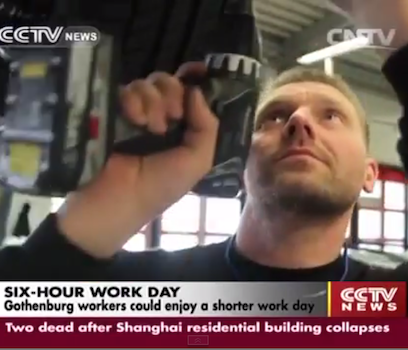
Screen shot of report by CCTV News on Gothenburg trial
The Abbott Government wants us to work more but who really benefits? Economist Warwick Smith argues that instead of handing more of our money over to the big four banks, we should follow the Swedish example where a 30 hour working week barely caused a blip in overall productivity.
ABBOTT AND Hockey’s 2015 budget continues their efforts to increase “workforce participation”. This is just another way of saying they want Australians to work more. Why? We’re told it’s to repair the budget and to maintain economic growth in the face of an aging population.
They are pursuing increased participation on multiple fronts including assaults on penalty rates, increasing childcare support, punitive measures against the unemployed and reduced family payments.
Whether or not we want to work more is not of interest to the government but we should be asking ourselves this question because there are alternatives to increasing participation.
“For those families, the decision to go back to work isn’t a choice, it’s a necessity.”
Let’s look at parents and childcare as an example. There are two primary reasons why we desire childcare. One is because both parents want to work; the other is because both parents have to work in order to meet the cost of living (mostly driven by the cost of housing).
Government policy can help from multiple directions. We can do as Abbott and Hockey are doing and make returning to full time work for both parents easier by making it financially more attractive.
Alternatively, government policy could improve housing affordability so that parents have the choice to stay at home with their kids or go to work and still be able to afford childcare. The latter option is not under consideration by the government.
Current government policy artificially raises the cost of housing by allowing negative gearing and the concessional tax treatment of capital gains. These policies make housing investment more profitable, increasing investment and raising prices. This effectively hands a greater proportion of wages over to the financial sector through interest payments or rent; wages that could be used to pay for childcare if that was what we wanted.
The government pretends to help us through childcare rebates but actually all they’re doing is assisting us to work more so that we can afford to pay for housing that government policy has made ludicrously expensive.
We live in one of the wealthiest countries in the world at the wealthiest time in human history. We should be thinking carefully about what we want to do with this opulence but instead we are just unthinkingly handing more and more of it over to the financial sector (primarily the big four banks). We could be using it to work less. That’s right, work less. We could mandate a standard 30 hour work week and six hour work day as they are trialling in Gothenburg in Sweden. There is growing evidence that overall productivity would barely fall as people working shorter days are more productive.
There are no fundamental economic barriers to doing this. We can afford it if we agree that it’s more important than ever-increasing home prices and ever-escalating material consumption. Actually, all we’d have to do is stall those things briefly in order to have six hour work days.
Gothenburg trials six hour working day CCTV News CCTV com English
But what about the need to address government debt and the never-ending budget deficits? This is another constructed crisis. As Richard Denniss of The Australia Institute points out, the government’s Intergenerational Report constructs the long-term budget crisis by making the assumption that we will regularly cut taxes in order to maintain a tax to GDP ratio of 23.9 per cent.
If we did not do that we would easily have sufficient taxation to allow for expenditure on aged pensions, Medicare, Denticare, disability insurance, Gonski etc., etc. as well as being materially better off as individuals. Yes, we could do with tax reform so that less of the tax falls on individual incomes and more on economic rent but that is mere administrative detail in the context of our great opulence. There is no crisis here. As a nation we have never been so wealthy.
So, in the absence of a crisis, what do we really want in terms of a future economy? Seems to me that a six hour work day is a terrific goal. There are obviously higher priority goals in terms of social justice and sustainability but reduced work hours would assist with achieving many of them. Imagine how much simpler and easier life would be if a standard full time job was 9 to 3 instead of 9 to 5. We can easily afford to do it — easily. It’s all about priorities.
Do we want to continue to slave away in order to feed the ever-growing financial sector or do we want more time to enjoy ourselves? Seems like a stupid question but it has already been answered for us and it’s not the answer we’d all choose.
Let’s continue the great Australian campaign that created the eight-hour day and push it down to six. We want it and we can afford it — but they won’t give it to us without a fight.
The treasurer’s endorsement of land tax in South Australia is an encouraging move away from his general opposition to taxation
‘The best taxes don’t take other people’s money but instead recoup public money that’s appropriated by rentseekers.’ Photograph: Joel Carrett/AAP
Joe Hockey recently said “I don’t like higher taxes; I am philosophically opposed to higher taxes … because if you increase taxes you’re just collecting someone else’s money.”
As usual, the reality is not as simple as Hockey makes out. Not all taxes are made equal. The best taxes don’t take other people’s money but instead recoup public money that’s appropriated by rentseekers.
His own department’s recently released tax working paper makes this abundantly clear by calculating the economic cost of different kinds of taxation. The imposition of taxes that target unearned income (economic rent) can actually improve the economy instead of imposing an “excess burden” on the economy as income based taxes, stamp duties and insurance taxes do.
“Tax bads, not goods” is a great first principle in taxation policy. Tax the activities that create public expenses, like pollution, gambling, tobacco, alcohol and asset price speculation; and reduce taxes on things you want to encourage, such as work and sustainable business activity.
Housing is a good example of the application of this principle. If we want affordable housing then we should tax speculation on land prices; first by removing tax breaks like negative gearing and the concessional treatment of capital gains, and then by increasing the use of land taxes.
This is not “collecting someone else’s money” because increases in land values and the use-value of land are not generated by the land-owner. They are the result of community activity, including public spending on infrastructure and services. Thus, taxing land value is actually just recouping public and community expenditure and effort.
Every single taxation review conducted by treasury under either side of politics has recommended greater use of land taxes in the tax mix. There would be many beneficial effects of these changes beyond increasing tax revenue, including:
Discouraging speculators from the housing market which would reduce price rises and make housing more affordable;
Causing some real estate investors to shift investments to productive economic activity, improving the economy and creating jobs;
Giving households more disposable income because they will be spending less on housing, thus stimulating other parts of the economy.
Joe Hockey has recently endorsed the South Australian Labor government’s proposal to replace stamp duties on real estate with an annual land tax. This is an encouraging development and demonstrates that Hockey appreciates the economic advantages of land taxes.
However, while Hockey is happy for South Australia to take action, he’s ruled out the abolition of negative gearing, a federal government subsidy for housing investment that substantially impacts housing affordability and is effectively the opposite of a land tax.
Instead of encouraging the states to increase the use of land taxes, the federal government could implement a nationwide broad-based land tax that would increase revenue and improve the economy.
In addition to land taxes, there are other taxes that are economically benevolent including resource rent taxes (along the lines of that proposed by the Henry tax review), carbon tax and dividend, the auctioning of electromagnetic spectrum and rent-based gambling taxes.
There is an apparent disconnect in Australia between our expectations and ambitions for our country and our willingness to pay the taxes necessary to achieve them. It seems to me that there are a few baseline standards that we would expect from a country in Australia’s enviable economic position as one of the richest countries in the world at the richest time in human history.
We should have world class health and education systems, virtually no poverty, a welfare system focussed on creating equality of opportunity for all citizens and an economy that’s based around environmental sustainability (ie we try not to leave the planet in worse condition than we inherit it).
If we want these things then we probably need to increase taxes to create the space for sufficient government expenditure. If we were to implement a broad-based land tax, a carbon tax, rent-based gambling taxes and an effective resource rent tax we could substantially cut company and personal tax, get rid of negative gearing and the concessional treatment of capital gains, get rid of insurance taxes and stamp duties and still have all the government services in the above wish list.
Our economy would also operate more efficiently, grow faster and government revenue would be more stable. I think you’d have to try pretty hard to find an economist who would disagree.
Economically, none of this is difficult. The real challenges are political. Tax reform is notoriously challenging because there are always losers and losers shout the loudest. Serious tax reform requires either the buffer of a popularity surplus or very strong political leadership with clear public communication. Hockey’s endorsement of the South Australian land tax proposal is an encouraging sign. Hopefully he will walk the walk when it comes to his own government’s tax reform program.
Public comments on the federal government’s tax discussion paper Re:think are due by 1 June 2015.
In the lead up to tonight’s federal budget treasurer Joe Hockey and prime minister Tony Abbott backed away from the strong rhetoric of deficit and debt emergencies that accompanied last year’s budget. However, they have still promised “a credible path to surplus” because the government “must live within its means”.
Modest budget deficits can be run sustainably forever and the government’s stated goal of getting to surplus and staying there is a path to economic ruin. But Joe Hockey did promise in 2013 that the Coalition government would achieve and maintain surpluses in its first term, and he’s been held to that ever since.
The budget outlines major new initiatives that will cost a total of $14.6 billion over the forward estimates, tax changes that will cost the budget $1.5 billion and savings measures totalling $11 billion. The net impact on the budget position will be about $5 billion in the red (although they are counting on measures from the last budget that remain stalled in the Senate to fill that gap).
The result of combining the budget measures with Treasury’s economic forecasts gives us a budget deficit of $35.1 billion in 2015-16, $25.8 billion in 2016-17, $14.4 billion in 2017-18 and $6.9 billion in 2018-19 for a total of $82.3 billion over the forward estimates. The budget is projected to be in surplus in 2019-20, a point well beyond the confidence of even the most foolhardy of economic forecasters. The surplus will be primarily achieved by allowing bracket creep to increase the tax-to-GDP ratio every year across the forward estimates from 23.9% of GDP in 2014-15 to 25.9% by 2018-19.
Margin for error
Economic forecasting is similar to weather forecasting. The system is complex and the links between the things we can measure now and future outcomes get weaker and weaker the further out the forecast or projection. We can tell with a pretty high degree of confidence what tomorrow’s economic conditions will be like, but once you start talking about next year we might as well be playing pin the tail on the donkey. No serious economic forecaster would tell you otherwise.
Importantly, the scale of the impact of the announced measures pales in comparison to the potential impact of external factors on the budget bottom line. Statement 7 of the budget, a section that few bother to read, reveals that the 90% confidence interval for the estimate of the 2015-16 budget balance is 3.5% of GDP (or $60 billion). That’s next year. Once we get out to 2016-17 that confidence interval doubles to 7% of GDP (more than $120 billion). In other words, Treasury is 90% sure that the 2016-17 budget balance will be somewhere between a $45 billion surplus and a $75 billion deficit.
As an illustration, in the five months since the government’s Mid-Year Economic and Fiscal Outlook (MYEFO), revenue estimates have fallen by $20.1 billion over the forward estimates. That forecast deterioration occurred in less than six months and is larger in scale than the total savings outlined in the budget across the forward estimates.
Does the budget represent a credible path to surplus? I think credible implies a lot more confidence than actually exists. Plausible might be a better word. Ultimately though it’s the wrong question to ask. We don’t actually need a credible path to surplus; we need a strong and robust economy. It is possible that we will be in surplus by 2019-20 as the budget suggests but previous budget outcomes tell us that the projection for 2019-20 has about as much chance of being accurate as I do of being struck by lightning on my way home tonight.
Rather than focus on budget balances in particular years, we should adopt measures that make our economy more robust. Modelling can help us with that. A robust economy can be supported by measures that keep the economy diverse and nimble, improve productivity, encourage sustainable and productive economic activity and create jobs. A few of the government’s measures tick some of those boxes but most are just a mix of housekeeping and window dressing.
As John Maynard Keynes said, “look after the unemployment and the budget will look after itself”. If you listen to the rhetoric, the government seems to agree. The word “jobs” is everywhere in the budget. However, actual measures that will result in greater employment are thin on the ground.
Confidence challenge
The flagship childcare package announced on Sunday aims to increase labour supply by nudging more parents into the workforce. However, in the absence of job creation, this is a pointless exercise because job seekers currently far outnumber available jobs. The same goes for the measures that tighten compliance conditions and increase penalties for job seekers.
The infrastructure programs, the tax cut for small businesses and the friendlier arrangements for start-ups will contribute somewhat towards the goal of job creation but will hardly be transformative. The changes to wage subsidies will have some impact on employment at the margins but are mostly just re-bundling and reorganising of existing measures with no new net expenditure. Business confidence is very low which means tax cuts and other benefits provided to small business are likely to be saved by many.
Nothing in this budget is likely to significantly improve business confidence, which is driven by weak demand. Clearly the budget modellers agree, as there appears to be negligible impact on jobs growth or the unemployment rate in the forward estimates despite the big headlines about “Growing Jobs”.
Similarly, the budget summary document highlights the importance of productivity growth for our future prosperity but the entire 152-page budget measures document mentions productivity improvements only twice and one of those is in relation to the now defunct East-West link road project in Melbourne.
The government’s recently published Intergenerational Report painted a grim picture of our future public finances but, as the Australia Institute’s executive director Richard Denniss pointed out, this grim scenario is constructed by assuming that the government will cut taxes every year from 2020 onwards. If they didn’t cut taxes they’d be flooded with revenue from bracket creep. In other words, the budget is in serious trouble – unless we increase revenue a little bit – in which case it will be fine. There is no economic problem here, there are only political problems.
Shh… don’t tell anyone, just keep talking about the deficit.






 Reconstructing Economics