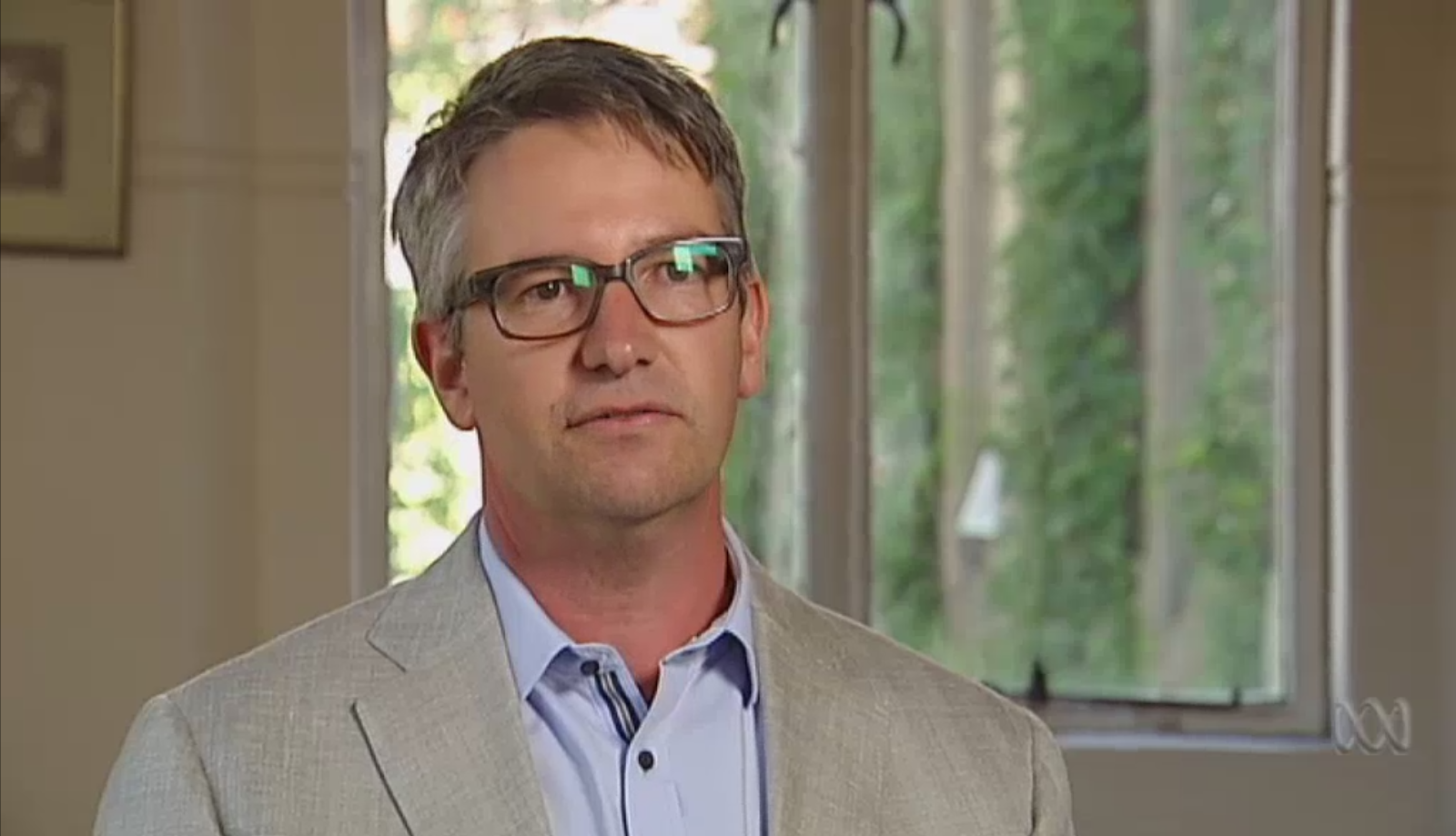
Video – Talking Justice 2015

A recording of my speech at Talking Justice has been uploaded to the Loddon Campaspe Community Legal Centre YouTube channel.

The speech is like a 22 minute summary of my writing over the last year.

Speech notes

Talking justice – Lifters and leaners: is it that simple?

By Warwick Smith

Before I begin I’d like to acknowledge the traditional owners of this land, the dja dja warung and pay my respects to their elders, both past and present. We can’t talk justice in this country without acknowledging the profound injustice experienced by Aboriginal Australians from the moment Europeans arrived here. In many important respects those injustices continue today.

The most difficult thing about giving a talk like this as an economist is deciding how far down the economics rabbit hole to go. The truth is often so far the opposite of the public discourse on economic topics that it can be impossible to turn your head far enough around to see it. The result is that people speaking the truth can appear unhinged. If I appear unhinged to you today, I invite you to come and talk to me after the session. Perhaps you’ll be able to straighten me out.

Richest country in the world at the richest time in human history

There’s one overarching thing I’d like you to keep in mind during this discussion about lifters and leaners: Australia, by many measures, is the richest country in the world at the richest time in human history. Just take a moment to let that sink in. The richest country in the world at the richest time in human history. Keep that in mind when you hear politicians telling you we can’t afford things. Keep that in mind when you hear about cuts to foreign aid, cuts to indigenous programs, cuts to dental care for kids and the absence of funding to help tackle domestic violence. The richest country in the world at the richest time in human history.

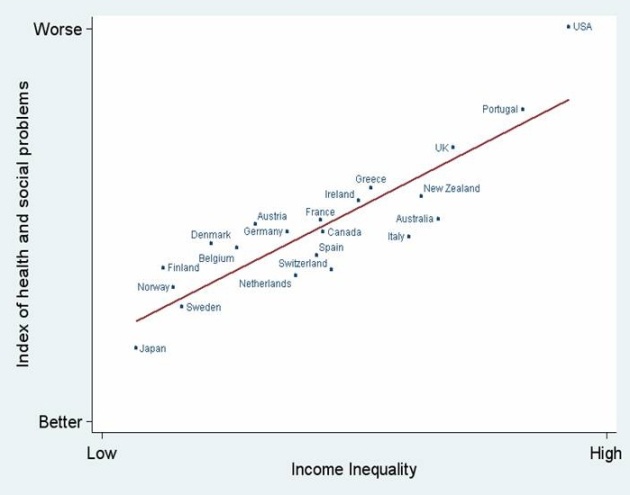
Why don’t we feel as wealthy as we are? I think there are several explanations for that. Increasing inequality is one reason. We’re very wealthy on average but we’re increasingly becoming a country of haves and have nots. We know from great pieces of work like “The Spirit Level” book by Wilkinson and Pickett that inequality has serious consequences for a vast array of health and social wellbeing indicators and these negative impacts fall on both the wealthy and the poor.

Another reason we don’t feel as wealthy as we are is because the adversarial political climate means that we have slightly more than half the politicians trying to run the country and slightly less than half trying to stop them. Part of the job of an opposition in this system is to talk about how terrible everything is – and, of course, how much better it would be if they were in power.

The ever increasing cost of housing is also vacuuming up much of our wealth, particularly in the capital cities, but the impact also flows through to regional centres like Bendigo. It’s becoming increasingly difficult to purchase your own home in Melbourne and Sydney on a normal income and increasingly difficult for parents to choose to stay at home with their young children rather than work. There is a lot that our governments could be doing to reduce the cost of housing but instead they take action to help us work more to meet the increasing costs.

We need to see this for what it is. The biggest beneficiaries of high land prices are the banks. By helping us to work more, by providing extra childcare assistance, the government is helping to prop up house prices so that an ever increasing proportion of national economic output can be absorbed by the banks and other lenders. This is not about helping us. If people can’t afford the astronomical house prices then the prices will fall. That would help us but it would be terrible for the banks’ bottom line. Why do the banks’ profits increase every year? Because people who are buying houses have to borrow more every year. This is not some inevitable law of economics, this is a policy choice. Current government policies, like negative gearing and the concessional treatment of capital gains, artificially prop up land prices and make real-estate investment artificially attractive.

Government finances

For the sin of being an economist I found myself in the federal budget lockup in Parliament House on Tuesday. Possibly the most striking thing about this year’s budget is that the debt and deficit crisis has disappeared. In opposition and in the first year of government the Coalition never stopped talking about this crisis that needed their urgent attention. The projected deficits have gotten bigger since last year but the crisis has evaporated, replaced with the need for “a credible path to surplus”.

As many of you will know, there never was a debt or deficit crisis in this country. It was just a scare campaign carefully targeted at the Labor party’s perceived weakness in economic management.

The entire narrative suggesting that governments, like households and businesses, must live within their means is fundamentally flawed. There are two main reasons why the finances of the federal government bear absolutely no resemblance to the finances of a household or business:

The first is that government revenue collection is enforceable. How many businesses and households can decide how much income they will make in a given year and imprison people if they don’t pay up? The Mafia might be the closest equivalent outside government.

The second reason is that the federal government is the issuer of our currency. This has profound implications for solvency and macro-economic management.

Let’s focus on this second one for a while. Presumably most of you have heard the term “quantitative easing”. Many have heard it, few understand what it is. The Federal Reserve Bank in the US and the European Central Bank have been creating money in order to increase liquidity in the banking system. What this means in practice is that they are buying risky assets and bonds from commercial banks in order to prop them up and, hopefully, encourage them to do more lending.

When I say they have been creating money I mean just that. Not with printing presses but with keyboards. The US Federal Reserve has created around $10 trillion dollars for the purpose of purchasing financial assets from commercial banks since the 2008 financial crisis. They do this by simply typing numbers into the database of accounts that banks hold with the Federal Reserve. OK, let’s see, $10 billion for Citibank, that’s 10 000 000 000 – enter. Now Citibank has $10 billion dollars more than it had a moment ago. That money didn’t come from anywhere. It wasn’t transferred from another account, it was simply typed into existence.

We’re told that governments can’t just create money to meet spending needs because it will cause out of control inflation. It’s funny how these rules suddenly become flexible when it’s the financial elite who will be the beneficiaries of money creation. US inflation stayed low right through this creation of $10 trillion.

This shows how blinkered we are to the fiscal policy options of a government that is sovereign with respect to its own currency – such as the Australian Government.

It would be possible to declare homelessness an emergency and simply create the money necessary to provide shelter to every homeless person in the country.

We could go to remote aboriginal communities and, instead of closing them down, hold community meetings where the community decides what their priorities are and then we could give them jobs to do it. Imagine that, we ask them what they want for their communities and then we provide them with jobs to do it – and we create the money out of thin air.

Now, I’m not saying that the government can just create and spend as much money as it wants on whatever it wants. That would cause out of control inflation. All I’m doing is pointing out that the entire conversation around government finances has been turned on its head. Quantitative easing shows us that it is inflation that limits government spending, not taxation or borrowing. When inflation risk is low, as it is in Australia right now, governments can spend more, regardless of whether they’ve got the tax revenue or have taken on extra debt.

This is a big conversation that can’t be fully had in the short time that we have here but I think raising it is still valuable. Those who are interested and have some economics knowledge should look up the work of Professor Bill Mitchell from the University of Newcastle. If you want more plain language explanations then look up my own writing in The Guardian and The Conversation.

I have indeed taken you quite a long way down the economics rabbit hole and, for the uninitiated, it’s disorienting down there. So much of our public discourse has been hijacked by ideology that we have become blinded to many policy options.

I hope that I have demonstrated, or at least hinted at the possibility, that affording to do things differently is not an issue. We are the wealthiest country in the world at the wealthiest time in human history. In addition to that we have fiscal policy options that free us from the artificially defined boundaries that our politicians currently operate within.

What could change look like?

So, we can afford change but what would this change look like? I believe there are some very good role models to help us create a more socially just society. The Nordic countries of northern Europe have strong economies, well-educated and healthy populations, low crime rates (Norway is closing down many of its prisons), relatively low levels of inequality, low levels of poverty and high scores on various measures of happiness and wellbeing.

They have high intergenerational economic mobility (meaning high equality of opportunity) and are generous in their foreign aid and commitments to global problems like climate change and refugees. Compared to us they have also made great strides in addressing the historical injustice experienced by their indigenous populations. They’re not perfect by any means but they show that there is a path to prosperity that does not require a persistent underclass or a subservience of the population to business interests.

Generous welfare systems in the Nordic countries do not lead to masses of welfare bludgers. The simple reality is that well educated and healthy people who have not grown up in conditions of poverty do not want to sit around for their whole lives taking handouts from the government. Only disconnected people with low self-esteem or those who have lost hope will opt out of making contributions to their society. People want to feel useful and to be part of something greater than themselves. Meaningful employment plays a big role in that.

There was a terrific program on Radio National’s Big Ideas a few weeks back called “The Stigma of Poverty”. I recommend listening to it if you haven’t already. It discussed the experience of poverty and described the impact on self-esteem and life prospects of living in poverty. These negative impacts were much more a product of stigma than they were of material deprivation. Politicians and others, including some business interests, are keen to paint the poor as “the other”. Labels like “leaners” create the impression that poor people are doing us hardworking Australians harm. How many people can lean on me before they drag me down too?

Once we create the poor as “the other” it becomes easy to justify poverty and justify punitive measures against them. If we can fool ourselves into believing that we live in the land of the fair go then the poor and the marginalised have only themselves to blame for their poverty and hardship.

Nationalism serves the same role with respect to foreigners who dare to try to come here and share in our opulence.

Equality of opportunity

One policy goal that is, at least in theory, shared across the political divide, is equality of opportunity. The simple reality is that equality of opportunity requires some degree of equality of outcome. Kids born to parents living in poverty will never have the same opportunities as kids born to wealthy parents, no matter how bright they are or how dedicated their parents are.

Breaking intergenerational poverty and disadvantage requires multi-faceted programs that begin at birth. Nurse-family partnership programs have demonstrated fantastic success in trials in aboriginal communities. They should be rolled out across the country, not only for indigenous Australians but for all Australians who would benefit from them. The cost of such a program would pay for itself many times, over the next generation. Next on the list of must-haves are world-class universal health and education systems. It doesn’t matter how smart a kid is; if they go to a crappy school or have poor health the odds will still be stacked against them.

Finally, we need an adequate social safety net so that nobody lives in abject poverty and, perhaps most importantly, no children grow up in poverty. The evidence shows us that when people are healthy and well educated they use generous social safety nets just to prop them up temporarily in difficult times and this helps them get back on their feet much faster. As I said earlier, people with any vestige of self-respect don’t want to sit around doing nothing. It’s only those who have been marginalised and stigmatised by their society who opt out.

Meritocracy cannot coexist with poverty

I wonder if it’s possible to believe in equality of opportunity and to also deny that the things I’ve just listed are necessary to achieve it. Those who argue that government needs to get out of the way and let business create prosperity are also those who generally advocate for a meritocracy. If we can believe that our society is meritocratic then we can both excuse our own opulence and dismiss the poverty and suffering of others. That meritocracy cannot coexist with poverty undermines much of the conservative small-government political project.

Power

It’s become unfashionable to talk about power but this is ultimately what my entire talk boils down to. We know that a more just society is possible. We know we can afford to create a nation where almost everybody has the chance to flourish. We’re not doing the things I listed above and, short of some kind of radical transformation or revolution, we’re not going to. The reason we’re not sharing our country’s vast wealth more equitably is because the people at the top don’t want to. It’s as simple as that. They create a social system that makes out they earned what they have and if you want some you have to earn it too.

Power operates like a ratchet because most individuals and organisations will use what power they have to defend and expand their power. Historically, power structures have only been reset through war and revolution. Democracy was supposed to change that. Theoretically we get the chance to reset power structures at every election. It worked for a while but eventually individuals and institutions built enough power to place themselves beyond the reach of democratic control.

When it comes to economic policy, both major parties share a lot more than they differ. Both make mindless promises about reaching surplus in such and such a year when most of the things that influence government budget balances are beyond their control. Both run scared at a whiff of disapproval from rating agencies that are run by the world’s financial elite and that played a major role in bringing about the global financial crisis. Neither party will touch policies that prop up property prices and through them the banks. Why? In part because the financial sector donates generously to both sides of politics. Such donations are not about helping one party or another win but are about removing issues from democratic scrutiny. If both major parties have the same policy on a subject then that subject is effectively silenced, even if the policy position is against the interests of the Australian public. So called free-trade agreements are a classic case.

This capture of both major parties represents an enormous challenge to any progressive political agenda. The structures of democracy still give people the power to change the system and reset power structures but doing so requires critical appraisal of the economic narrative we are bombarded with. Such critical appraisal in turn requires individuals to be well-informed and well educated in critical thinking. As it stands, a large proportion of the people don’t even understand how preferential voting works, let alone the intricacies of monetary economics. This is a catch 22 of enormous significance. In order to challenge those with power we need to strengthen democracy. However, those with power have no interest in strengthening democracy because it is the ultimate threat to them.

One of the greatest attempts to methodically describe a fair society was presented by John Rawls in A Theory of Justice published in 1971. He proposed a thought experiment known as ‘the original position’ and the general gist of it was that you imagine that you are designing a society from the ground up but you don’t know your place in the society that you are creating. You could end up in any role, any gender, any race or be born to any parents within that system. It’s a fantastic thought experiment and it can lead to many different ends but tends to inexorably promote equality of opportunity and equality before the law.

If people were to be dropped into an existing society without knowing what place they would take in that society I reckon almost everyone, if well informed, would opt for a Nordic country (unless perhaps you take into account the weather). I believe that tells us a great deal about justice in Australia and where we are headed. Our current trajectory is taking us slowly towards a more American social system with massive inequality and low intergenerational social and economic mobility. That’s why they call the United States the land of opportunity – because it’s the very opposite of the truth.

Alright, that’s enough. Let’s come out of the rabbit hole and back into reality – how about that budget eh? Back to surplus in 2019. Good old Joe Hockey.

Thank you.
Posted in Australian politics, democracy, Political philosophy | Tagged , , , , | 2 Comments

The Coalition want us to work more so we can give more to the banks – Independent Australia

By Warwick Smith

This article was first published at Independent Australia.

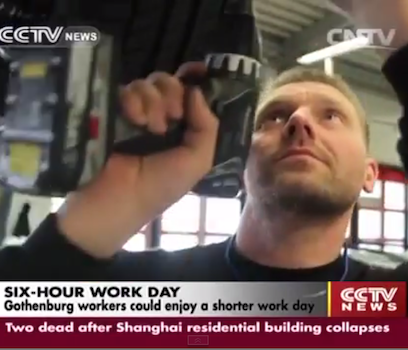
Screen shot of report by CCTV News on Gothenburg trial

The Abbott Government wants us to work more but who really benefits? Economist Warwick Smith argues that instead of handing more of our money over to the big four banks, we should follow the Swedish example where a 30 hour working week barely caused a blip in overall productivity.

ABBOTT AND Hockey’s 2015 budget continues their efforts to increase “workforce participation”. This is just another way of saying they want Australians to work more. Why? We’re told it’s to repair the budget and to maintain economic growth in the face of an aging population.

They are pursuing increased participation on multiple fronts including assaults on penalty rates, increasing childcare support, punitive measures against the unemployed and reduced family payments.

Whether or not we want to work more is not of interest to the government but we should be asking ourselves this question because there are alternatives to increasing participation.

Social Services Minister Scott Morrison on low income earners returning to work after having children.

“For those families, the decision to go back to work isn’t a choice, it’s a necessity.”

Let’s look at parents and childcare as an example. There are two primary reasons why we desire childcare. One is because both parents want to work; the other is because both parents have to work in order to meet the cost of living (mostly driven by the cost of housing).

Government policy can help from multiple directions. We can do as Abbott and Hockey are doing and make returning to full time work for both parents easier by making it financially more attractive.

Alternatively, government policy could improve housing affordability so that parents have the choice to stay at home with their kids or go to work and still be able to afford childcare. The latter option is not under consideration by the government.

Current government policy artificially raises the cost of housing by allowing negative gearing and the concessional tax treatment of capital gains. These policies make housing investment more profitable, increasing investment and raising prices. This effectively hands a greater proportion of wages over to the financial sector through interest payments or rent; wages that could be used to pay for childcare if that was what we wanted.

The government pretends to help us through childcare rebates but actually all they’re doing is assisting us to work more so that we can afford to pay for housing that government policy has made ludicrously expensive.

We live in one of the wealthiest countries in the world at the wealthiest time in human history. We should be thinking carefully about what we want to do with this opulence but instead we are just unthinkingly handing more and more of it over to the financial sector (primarily the big four banks). We could be using it to work less. That’s right, work less. We could mandate a standard 30 hour work week and six hour work day as they are trialling in Gothenburg in Sweden. There is growing evidence that overall productivity would barely fall as people working shorter days are more productive.

There are no fundamental economic barriers to doing this. We can afford it if we agree that it’s more important than ever-increasing home prices and ever-escalating material consumption. Actually, all we’d have to do is stall those things briefly in order to have six hour work days.

But what about the need to address government debt and the never-ending budget deficits? This is another constructed crisis. As Richard Denniss of The Australia Institute points out, the government’s Intergenerational Report constructs the long-term budget crisis by making the assumption that we will regularly cut taxes in order to maintain a tax to GDP ratio of 23.9 per cent.

If we did not do that we would easily have sufficient taxation to allow for expenditure on aged pensions, Medicare, Denticare, disability insurance, Gonski etc., etc. as well as being materially better off as individuals. Yes, we could do with tax reform so that less of the tax falls on individual incomes and more on economic rent but that is mere administrative detail in the context of our great opulence. There is no crisis here. As a nation we have never been so wealthy.

So, in the absence of a crisis, what do we really want in terms of a future economy? Seems to me that a six hour work day is a terrific goal. There are obviously higher priority goals in terms of social justice and sustainability but reduced work hours would assist with achieving many of them. Imagine how much simpler and easier life would be if a standard full time job was 9 to 3 instead of 9 to 5. We can easily afford to do it — easily. It’s all about priorities.

Do we want to continue to slave away in order to feed the ever-growing financial sector or do we want more time to enjoy ourselves? Seems like a stupid question but it has already been answered for us and it’s not the answer we’d all choose.

Let’s continue the great Australian campaign that created the eight-hour day and push it down to six. We want it and we can afford it — but they won’t give it to us without a fight.

You can follow Warwick Smith on Twitter @RecoEco or check out his blog reconstructingeconomics.com.

Posted in Australian politics, housing affordability | Tagged , , , , | 1 Comment

Joe Hockey is beginning to understand not all taxes are created equal – The Guardian

Originally published at The Guardian.

The treasurer’s endorsement of land tax in South Australia is an encouraging move away from his general opposition to taxation

‘The best taxes don’t take other people’s money but instead recoup public money that’s appropriated by rentseekers.’ Photograph: Joel Carrett/AAP

Joe Hockey recently said “I don’t like higher taxes; I am philosophically opposed to higher taxes … because if you increase taxes you’re just collecting someone else’s money.”

As usual, the reality is not as simple as Hockey makes out. Not all taxes are made equal. The best taxes don’t take other people’s money but instead recoup public money that’s appropriated by rentseekers.

His own department’s recently released tax working paper makes this abundantly clear by calculating the economic cost of different kinds of taxation. The imposition of taxes that target unearned income (economic rent) can actually improve the economy instead of imposing an “excess burden” on the economy as income based taxes, stamp duties and insurance taxes do.

“Tax bads, not goods” is a great first principle in taxation policy. Tax the activities that create public expenses, like pollution, gambling, tobacco, alcohol and asset price speculation; and reduce taxes on things you want to encourage, such as work and sustainable business activity.

Housing is a good example of the application of this principle. If we want affordable housing then we should tax speculation on land prices; first by removing tax breaks like negative gearing and the concessional treatment of capital gains, and then by increasing the use of land taxes.

This is not “collecting someone else’s money” because increases in land values and the use-value of land are not generated by the land-owner. They are the result of community activity, including public spending on infrastructure and services. Thus, taxing land value is actually just recouping public and community expenditure and effort.

Every single taxation review conducted by treasury under either side of politics has recommended greater use of land taxes in the tax mix. There would be many beneficial effects of these changes beyond increasing tax revenue, including:

  • Discouraging speculators from the housing market which would reduce price rises and make housing more affordable;
  • Causing some real estate investors to shift investments to productive economic activity, improving the economy and creating jobs;
  • Giving households more disposable income because they will be spending less on housing, thus stimulating other parts of the economy.

Joe Hockey has recently endorsed the South Australian Labor government’s proposal to replace stamp duties on real estate with an annual land tax. This is an encouraging development and demonstrates that Hockey appreciates the economic advantages of land taxes.

However, while Hockey is happy for South Australia to take action, he’s ruled out the abolition of negative gearing, a federal government subsidy for housing investment that substantially impacts housing affordability and is effectively the opposite of a land tax.

Instead of encouraging the states to increase the use of land taxes, the federal government could implement a nationwide broad-based land tax that would increase revenue and improve the economy.

In addition to land taxes, there are other taxes that are economically benevolent including resource rent taxes (along the lines of that proposed by the Henry tax review), carbon tax and dividend, the auctioning of electromagnetic spectrum and rent-based gambling taxes.

There is an apparent disconnect in Australia between our expectations and ambitions for our country and our willingness to pay the taxes necessary to achieve them. It seems to me that there are a few baseline standards that we would expect from a country in Australia’s enviable economic position as one of the richest countries in the world at the richest time in human history.

We should have world class health and education systems, virtually no poverty, a welfare system focussed on creating equality of opportunity for all citizens and an economy that’s based around environmental sustainability (ie we try not to leave the planet in worse condition than we inherit it).

If we want these things then we probably need to increase taxes to create the space for sufficient government expenditure. If we were to implement a broad-based land tax, a carbon tax, rent-based gambling taxes and an effective resource rent tax we could substantially cut company and personal tax, get rid of negative gearing and the concessional treatment of capital gains, get rid of insurance taxes and stamp duties and still have all the government services in the above wish list.

Our economy would also operate more efficiently, grow faster and government revenue would be more stable. I think you’d have to try pretty hard to find an economist who would disagree.

Economically, none of this is difficult. The real challenges are political. Tax reform is notoriously challenging because there are always losers and losers shout the loudest. Serious tax reform requires either the buffer of a popularity surplus or very strong political leadership with clear public communication. Hockey’s endorsement of the South Australian land tax proposal is an encouraging sign. Hopefully he will walk the walk when it comes to his own government’s tax reform program.

  • Public comments on the federal government’s tax discussion paper Re:think are due by 1 June 2015.
Posted in Australian politics, housing affordability, Land tax, tax economics | Tagged , , , | 1 Comment

Path to budget surplus built on shifting foundations – The Conversation

Treasurer Joe Hockey and Finance Minister Mathias Cormann speak to media during the 2015 budget lockup. AAP Image/Lukas Coch

Warwick Smith, University of Melbourne

In the lead up to tonight’s federal budget treasurer Joe Hockey and prime minister Tony Abbott backed away from the strong rhetoric of deficit and debt emergencies that accompanied last year’s budget. However, they have still promised “a credible path to surplus” because the government “must live within its means”.

Modest budget deficits can be run sustainably forever and the government’s stated goal of getting to surplus and staying there is a path to economic ruin. But Joe Hockey did promise in 2013 that the Coalition government would achieve and maintain surpluses in its first term, and he’s been held to that ever since.

The budget outlines major new initiatives that will cost a total of $14.6 billion over the forward estimates, tax changes that will cost the budget $1.5 billion and savings measures totalling $11 billion. The net impact on the budget position will be about $5 billion in the red (although they are counting on measures from the last budget that remain stalled in the Senate to fill that gap).

Infographic: 2015 federal budget at a glance

The result of combining the budget measures with Treasury’s economic forecasts gives us a budget deficit of $35.1 billion in 2015-16, $25.8 billion in 2016-17, $14.4 billion in 2017-18 and $6.9 billion in 2018-19 for a total of $82.3 billion over the forward estimates. The budget is projected to be in surplus in 2019-20, a point well beyond the confidence of even the most foolhardy of economic forecasters. The surplus will be primarily achieved by allowing bracket creep to increase the tax-to-GDP ratio every year across the forward estimates from 23.9% of GDP in 2014-15 to 25.9% by 2018-19.

Margin for error

Economic forecasting is similar to weather forecasting. The system is complex and the links between the things we can measure now and future outcomes get weaker and weaker the further out the forecast or projection. We can tell with a pretty high degree of confidence what tomorrow’s economic conditions will be like, but once you start talking about next year we might as well be playing pin the tail on the donkey. No serious economic forecaster would tell you otherwise.

Importantly, the scale of the impact of the announced measures pales in comparison to the potential impact of external factors on the budget bottom line. Statement 7 of the budget, a section that few bother to read, reveals that the 90% confidence interval for the estimate of the 2015-16 budget balance is 3.5% of GDP (or $60 billion). That’s next year. Once we get out to 2016-17 that confidence interval doubles to 7% of GDP (more than $120 billion). In other words, Treasury is 90% sure that the 2016-17 budget balance will be somewhere between a $45 billion surplus and a $75 billion deficit.

As an illustration, in the five months since the government’s Mid-Year Economic and Fiscal Outlook (MYEFO), revenue estimates have fallen by $20.1 billion over the forward estimates. That forecast deterioration occurred in less than six months and is larger in scale than the total savings outlined in the budget across the forward estimates.

Does the budget represent a credible path to surplus? I think credible implies a lot more confidence than actually exists. Plausible might be a better word. Ultimately though it’s the wrong question to ask. We don’t actually need a credible path to surplus; we need a strong and robust economy. It is possible that we will be in surplus by 2019-20 as the budget suggests but previous budget outcomes tell us that the projection for 2019-20 has about as much chance of being accurate as I do of being struck by lightning on my way home tonight.

Rather than focus on budget balances in particular years, we should adopt measures that make our economy more robust. Modelling can help us with that. A robust economy can be supported by measures that keep the economy diverse and nimble, improve productivity, encourage sustainable and productive economic activity and create jobs. A few of the government’s measures tick some of those boxes but most are just a mix of housekeeping and window dressing.

As John Maynard Keynes said, “look after the unemployment and the budget will look after itself”. If you listen to the rhetoric, the government seems to agree. The word “jobs” is everywhere in the budget. However, actual measures that will result in greater employment are thin on the ground.

Confidence challenge

The flagship childcare package announced on Sunday aims to increase labour supply by nudging more parents into the workforce. However, in the absence of job creation, this is a pointless exercise because job seekers currently far outnumber available jobs. The same goes for the measures that tighten compliance conditions and increase penalties for job seekers.

The infrastructure programs, the tax cut for small businesses and the friendlier arrangements for start-ups will contribute somewhat towards the goal of job creation but will hardly be transformative. The changes to wage subsidies will have some impact on employment at the margins but are mostly just re-bundling and reorganising of existing measures with no new net expenditure. Business confidence is very low which means tax cuts and other benefits provided to small business are likely to be saved by many.

Nothing in this budget is likely to significantly improve business confidence, which is driven by weak demand. Clearly the budget modellers agree, as there appears to be negligible impact on jobs growth or the unemployment rate in the forward estimates despite the big headlines about “Growing Jobs”.

Similarly, the budget summary document highlights the importance of productivity growth for our future prosperity but the entire 152-page budget measures document mentions productivity improvements only twice and one of those is in relation to the now defunct East-West link road project in Melbourne.

The government’s recently published Intergenerational Report painted a grim picture of our future public finances but, as the Australia Institute’s executive director Richard Denniss pointed out, this grim scenario is constructed by assuming that the government will cut taxes every year from 2020 onwards. If they didn’t cut taxes they’d be flooded with revenue from bracket creep. In other words, the budget is in serious trouble – unless we increase revenue a little bit – in which case it will be fine. There is no economic problem here, there are only political problems.

Shh… don’t tell anyone, just keep talking about the deficit.

The Conversation

Warwick Smith is Research economist at University of Melbourne.

This article was originally published on The Conversation.
Read the original article.

H

Posted in Australian politics, political economy | Tagged , , , , | Leave a comment

Interviewed for podcast: “Is it worth voting?”

By Warwick Smith

I was interviewed by Abla George for the first of a new podcast series InformMyOpinion. The topic, “is it worth voting?”, was prompted by record levels of disengagement in politics in the UK in the leadup to this weekend’s election. It’s an important topic that I tackled in a three part series in The Guardian last year.

You can stream or download the podcast here.

For parochial friends and family who just want to hear my bit, it’s at about the 36 minute mark, though I recomend listening to the whole thing.

My writing is taking a brief break while I prepare for next week’s federal budget lockup where I’ll be part of the team from The Conversation. The following Saturday (16th May) I’ll be speaking at Talking Justice 2015 in Bendigo about “lifters and leaners” and then on a discussion panel with Eva Cox, Professor Mick Dodson and Ken Marchingo.

Posted in democracy, Political philosophy, radio interview | Tagged , , , , | Leave a comment

Twiggy’s not so crazy cartel idea

By Warwick Smith

Andrew (Twiggy) Forrest, recently suggested the big iron ore producers in Australia should cap production of iron ore in order to lift prices. This suggestion has been attacked and ridiculed by the other miners, by the Australian government and by the ACCC. While I certainly don’t think that allowing the mining companies to reduce production in order to make more money out of our mineral resources is a good idea, perhaps we, the Australian people, should have a think about the way we go about selling of our natural capital. In Australia mineral resources are not owned by the mining company or by the owner of the land underneath which they lie, they are owned by the Australian people.

Selling mineral resources is not like selling manufactured commodities. It is an asset sale. We own the assets and we effectively sell them to the mining companies who then extract and process them and sell them on the international market. Under the current arrangement, when the price of the assets go up, it’s not us, the owners, who benefit. It’s the mining companies. The Mineral Resource Rent Tax was one approach (somewhat flawed though it was) to rectifying this failure by governments to get a good price for our assets. The Coalition bowed to pressure from the mining industry and repealed the mining tax without citing a single coherent national interest reason.

There are other ways we could capture more of the value of our assets. One way would be to emulate the Saudi Arabian approach to oil production. We could tender out the job of digging up our resources and then sell them ourselves. Competitive tenders would ensure mining company activity continued in the country but the miners would simply get an ordinary return for their effort and we, the owners of the resources, would receive both the benefits and the risks associated with volatile international prices.

The goal of asset sales is generally to sell while the price is high and hold on to the asset when the price is low. This is effectively what Andrew Forrest was suggesting the miners should do. The problem with this is that the assets are ours, not his. We should think about how and when we sell our assets instead of just digging them up and shipping them out as fast as we possibly can. If we tendered out the process of extracting and refining resources but maintained public ownership the entire time, we could have this conversation publicly and decide what we want done with our assets. The miners of course would hate this and would call it anti-competitive and market interference and many other economic swear words but it would be nothing of the sort.

Under no other circumstances are public assets sold in a manner that minimises the public return from the sale. Why do we do this with our mineral resources?

Posted in Australian politics, political economy | Tagged , , , , , , | Leave a comment

TV appearance on ABC’s The Business

I was interviewed for a segment on political donations by financial institutions that aired on Wednesday night on The Business on ABC TV. This followed on from a piece I wrote for The Guardian last year. It’s great the ABC is looking at this issue but it’s a shame it doesn’t get more airplay and more serious discussion.

You can watch the video on ABC iView if you’re in Australia or at The Business.

Thanks to Andrew Robertson at the ABC for putting this segment together.

The Business screen capture

Posted in Australian politics, democracy, Media appearance, political economy, TV | Tagged , , , | Leave a comment

A super con – The Monthly

Why compulsory superannuation benefits the financial industry and the rich at the expense of everyone else

Published at The Monthly

Superannuation is mostly a con. It involves the funnelling of vast amounts of wealth from wage-earners to the financial sector, and continues the neoliberal project of fracturing and individualising our hopes and ambitions.

The primary beneficiaries of our super system are fund managers and other financial parasites. Second to them are the very wealthy who are best placed to make use of generous superannuation-related tax concessions to minimise their tax. This financial year alone we are expected to pay $17 billion in superannuation tax concessions to the wealthiest 10% of the population.

Meanwhile, stay-at-home parents and carers, who are overwhelmingly women, are short-changed because their work does not contribute to their standard of living in retirement. Women are currently retiring with average super balances close to half that of men. That alone should be enough to make us rethink the entire system.

Thanks to compulsory superannuation, every payday a substantial proportion of everybody’s wages gets funnelled into speculative markets. This is akin to a Ponzi scheme, where investments only derive returns as long as new money keeps rolling in. Something has to be done with all the cash, and there are few good options outside the stock market, where at least a third of the funds ends up.

It’s no coincidence that the super industry is keen to ramp up compulsory contributions – from 9% to 12% – just as the baby boomers are retiring. The super industry is afraid its gravy train will grind to a halt. It wants to maintain the flow of funds coming its way even as the proportion of wage-earners falls. But that’s not the end of the super con.

We’re all familiar with the economic threat posed by an ageing population. As the population ages, the dependency ratio climbs – fewer and fewer workers for each retired person. Compulsory super is one of our principal strategies for coping with this. We’re told that if most retired Australians can be self-funded, then the burden of supporting them will not be too great for those left in the workforce.

But a growing number of economists around the world, including the University of Newcastle’s Professor Bill Mitchell, argue that this narrative is fundamentally flawed. When we get to 2040 and the majority are retiring with a nest egg from a lifetime of Paul Keating’s compulsory super, the retirees are going to spend that money on goods and services. Those goods and services will have to be supplied by the remaining people of working age. Starting to see the problem?

Our collective standard of living is determined by our capacity to produce goods and services at the time they are required. Saving money is not the same as saving goods and services. If those who are still working can’t supply all the things that the retirees want to spend their money on, prices will go up. This inflation will devalue the superannuation savings and the whole thing will have been for nothing. Alternatively, the retirees could import many of the goods and services they desire. This would have an impact on our balance of trade, driving the value of the dollar down and once again reducing the purchasing power of the retirees.

The important lesson from this is that the financialisation of the economy has gone so far that we often can’t see the real economy for all the money. Looking at the real economy, it’s obvious that no matter how much money retirees have, it’s the remaining workforce who will have to provide for their needs. Same is true if they’re all on government pensions.

If we want to improve our capacity to support an ageing population, then our focus should be on full employment and productivity improvements so that those remaining workers can produce enough to maintain everybody’s quality of life. Productivity improvements come from three main sources: investment in education and training, investment in research and development, and investment in infrastructure. If we focus our spare capacity on making our workforce more productive as the population ages, then we can deal with the demographic time bomb. We’ll also defuse the inflation time bomb of superannuation.

Despite the hysteria around government budgets, we could easily afford to dump compulsory super and all super-related tax concessions and dramatically increase the pension to provide everybody with a dignified life after retirement. Putting all that super back into incomes will increase government revenue through taxation, increase home ownership on retirement and improve the material standard of living of many wage-earners. So long as we focus on real problems and real solutions, the ageing population is well within our power to manage in both a sustainable and civilised manner.

We can work together to look after our retired citizens, rather than giving in to the notion that every person must either fend for themselves or live below the poverty line on miserly government pensions. We’ll find that getting up off our nest egg and caring about others also makes us happier and healthier. It’s win-win. Let’s dump compulsory super.

Posted in Australian politics, Economic theory, Inequality | Tagged , , , , | Leave a comment

The diabolical problem of housing affordability

By Warwick Smith

Fairfax economics editor, Peter Martin, recenly wrote a piece defending Joe Hockey’s suggestion that we should let first home buyers access part of their superannuation for buying a home while also abolishing negative gearing.

Before reading Peter’s piece I had been firmly of the opinion it was a terrible idea to allow super to be used for housing because, just like first home buyer grants, it would just drive prices up. We should be bringing prices down if we really want to be tackling affordability for first home buyers.

After reading the fairfax article I was much less confident in my views. I tweeted that Peter’s piece had given me food for thought and a twitter debate began with people who still fellt strongly it was a terrible plan. The debate was unproductive because twitter is no place for meaningful debate unless it can be conducted through links. This blog post is aimed at spelling out my thinking on the subject.

Housing prices are clearly distorted by government policy allowing negative gearing and giving concessional tax treatment to capital gains. The economic rent from land ownership also makes real estate investment artificially attractive. We should get rid of the distortions in the real estate sector and improve housing affordability. I’ve written about this on several occasions before.

If we could wave a magic wand and reset prices and mortgages the solution would be pretty easy. Get rid of negative gearing and the concessional treatment of capital gains and increase our use of land taxes, preferably through a nationally leveraged land value tax.

However, we don’t have the magic wand and any substantial reduction in land prices would leave many people owing more on their mortgages than their homes were worth. We could readily cause our own financial crisis. In  order to avoid these problems our solutions probably need to be slow and steady. We need to keep land value rises below wage rises. This way we slowly improve housing affordability over time. The problem is that this long view doesn’t help those currently trying to buy their first home.

This is where Peter Martin’s suggestion comes in. If we were to dump negative gearing we could stall house price growth, possibly even cause prices to fall a little. If we also allowed first home buyers (FHBs) to access super for deposits, it would make housing relatively more affordable for them compared to others. Yes, it would drive prices up a little but not by as much as it increased affordability for FHBs. So long as measures are introduced that discourage housing as an investment at the same time as you increase the capacity of FHBs to enter the market, your net effect can still be to dampen price growth below wage growth.

If just getting rid of negative gearing isn’t initially enough to keep prices down then you can phase in the elimination of concessional treatment of capital gains and also phase in over a long period the introduction of land taxes (as the ACT is currently doing). These are good long term solutions but they don’t help FHBs now. Allowing them access to their super does help them now and so long as doing this doesn’t push price rises above wage growth then you’re still meeting your long term goals. Once all of the other distortions have washed through the system you could also stop allowing FHBs to use super for housing because it would be affordable for them anyway.

Sorry about the absence of data @RationalRadical.

Posted in Land tax, tax economics | Tagged , | 2 Comments

Conservative ideology and the Intergenerational Report: why Hockey had to remove all reference to inequality

By Warwick Smith

A search of the government’s recently released Intergenerational Report for the word “inequality” yields zero results. The same is true for “income distribution” and “wealth distribution”. This is not surprising because conservatives are basically forced by their other beliefs to play down the importance of inequality.

As many others have pointed out, the Intergenerational Report is an inherently political document and is much more informative about the current government than it is about the actual future of the country. The very short treatment of climate change in the report is a case in point. Another important element that was present in the 2010 report that is entirely absent from the 2015 version is any mention of wealth and income distribution. Instead, the 2015 report relies entirely on averages for reporting income and wealth.

Using the average (or mean) value for income and wealth can conceal very important information. Distributions can be measured and modelled just as averages can be measured and modelled. Not reporting on or modelling distributions is therefore a deliberate choice.

If you have 100 people in your economy and 99 are in abject poverty while one is a millionaire, average wealth is about $10,000. If that millionaire doubles their wealthy to $2 million the average wealth also doubles to $20,000. Based purely on averages it looks like things are going really well despite 99 percent of the population living in poverty and nothing improving for them. This is not an entirely unrealistic scenario. In the United States, since the 2008 financial crisis, a staggering 93% of income growth has gone to the top 1% of income earners. The average income has grown but the bottom 99% of income earners have mostly seen wages stagnate or fall. If we only heard about average incomes during that period we could be fooled into thinking US incomes are recovering from the financial crisis.

Equality of outcome is required for equality of opportunity

The negative consequences of extreme inequality have been very well documented by numerous studies in a variety of fields. Nations with high levels of inequality have poorer outcomes across a huge range of health and wellbeing measures, from teenage pregnancies to drug and alcohol problems.

Income inequality has a huge impact on health and wellbeing even among wealthy western nations. Graph from ‘The Spirit Level’.

Conservatives, by definition, tend to defend the status quo with respect to institutional structures. This means that if current structures are resulting in increased inequality then they are driven to dismiss or play down the importance of inequality. In fact, many conservatives consider inequality to be essential in order to provide incentives for hard work. However, there is only value in an incentive to climb the ladder if climbing the ladder is possible.

The reality is that the more unequal a country is, the lower equality of opportunity they tend to have. Equality of opportunity relies, to some extent, on a degree of equality of outcome. Parents in poverty cannot provide their children with the same opportunities that wealthy parents can no matter how intelligent, well intentioned or well informed they are. Similarly, children in poor communities will likely attend schools with poorer student outcomes and lower teaching standards than those in wealthy neighbourhoods.

When it comes to inequality, conservatives are trapped between conflicting articles of faith; small government and meritocracy. The data imply you cannot have both. Meritocracy requires considerable government intervention, particularly in education, health and welfare.

The policy leaders in this area are the Nordic nations of northern Europe and we would do well to pay more attention to their successes. Not only do these nations have relatively low levels of inequality, they have high income mobility and score very well on measures of life satisfaction and wellbeing. They achieve this through a complex web of legislation but it is underpinned by well-funded universal healthcare, education and welfare systems. The effect of these is to provide more than just a safety net but rather a baseline standard of living such that everyone can live a dignified life. This seems to me the very essence of a civilised society and is certainly within reach of all wealthy western nations.

We can see why Hockey and Abbott chose to remove references to inequality from their Intergenerational Report. Honest discussion of inequality reveals the incoherence of their broader social vision. When reduced to outcomes, the conservative political agenda of defending current structures and institutions manifests as simply protecting the interests of wealth and power at the expense of the rest. That’s all it ever has been – the rest is smoke and mirrors.

Posted in Australian politics, Inequality, Political philosophy | Tagged , , , , , | Leave a comment