Interviewed for podcast: “Is it worth voting?”

By Warwick Smith

I was interviewed by Abla George for the first of a new podcast series InformMyOpinion. The topic, “is it worth voting?”, was prompted by record levels of disengagement in politics in the UK in the leadup to this weekend’s election. It’s an important topic that I tackled in a three part series in The Guardian last year.

You can stream or download the podcast here.

For parochial friends and family who just want to hear my bit, it’s at about the 36 minute mark, though I recomend listening to the whole thing.

My writing is taking a brief break while I prepare for next week’s federal budget lockup where I’ll be part of the team from The Conversation. The following Saturday (16th May) I’ll be speaking at Talking Justice 2015 in Bendigo about “lifters and leaners” and then on a discussion panel with Eva Cox, Professor Mick Dodson and Ken Marchingo.

Posted in democracy, Political philosophy, radio interview | Tagged , , , , | Leave a comment

Twiggy’s not so crazy cartel idea

By Warwick Smith

Andrew (Twiggy) Forrest, recently suggested the big iron ore producers in Australia should cap production of iron ore in order to lift prices. This suggestion has been attacked and ridiculed by the other miners, by the Australian government and by the ACCC. While I certainly don’t think that allowing the mining companies to reduce production in order to make more money out of our mineral resources is a good idea, perhaps we, the Australian people, should have a think about the way we go about selling of our natural capital. In Australia mineral resources are not owned by the mining company or by the owner of the land underneath which they lie, they are owned by the Australian people.

Selling mineral resources is not like selling manufactured commodities. It is an asset sale. We own the assets and we effectively sell them to the mining companies who then extract and process them and sell them on the international market. Under the current arrangement, when the price of the assets go up, it’s not us, the owners, who benefit. It’s the mining companies. The Mineral Resource Rent Tax was one approach (somewhat flawed though it was) to rectifying this failure by governments to get a good price for our assets. The Coalition bowed to pressure from the mining industry and repealed the mining tax without citing a single coherent national interest reason.

There are other ways we could capture more of the value of our assets. One way would be to emulate the Saudi Arabian approach to oil production. We could tender out the job of digging up our resources and then sell them ourselves. Competitive tenders would ensure mining company activity continued in the country but the miners would simply get an ordinary return for their effort and we, the owners of the resources, would receive both the benefits and the risks associated with volatile international prices.

The goal of asset sales is generally to sell while the price is high and hold on to the asset when the price is low. This is effectively what Andrew Forrest was suggesting the miners should do. The problem with this is that the assets are ours, not his. We should think about how and when we sell our assets instead of just digging them up and shipping them out as fast as we possibly can. If we tendered out the process of extracting and refining resources but maintained public ownership the entire time, we could have this conversation publicly and decide what we want done with our assets. The miners of course would hate this and would call it anti-competitive and market interference and many other economic swear words but it would be nothing of the sort.

Under no other circumstances are public assets sold in a manner that minimises the public return from the sale. Why do we do this with our mineral resources?

Posted in Australian politics, political economy | Tagged , , , , , , | Leave a comment

TV appearance on ABC’s The Business

I was interviewed for a segment on political donations by financial institutions that aired on Wednesday night on The Business on ABC TV. This followed on from a piece I wrote for The Guardian last year. It’s great the ABC is looking at this issue but it’s a shame it doesn’t get more airplay and more serious discussion.

You can watch the video on ABC iView if you’re in Australia or at The Business.

Thanks to Andrew Robertson at the ABC for putting this segment together.

The Business screen capture

Posted in Australian politics, democracy, Media appearance, political economy, TV | Tagged , , , | Leave a comment

A super con – The Monthly

Why compulsory superannuation benefits the financial industry and the rich at the expense of everyone else

Published at The Monthly

Superannuation is mostly a con. It involves the funnelling of vast amounts of wealth from wage-earners to the financial sector, and continues the neoliberal project of fracturing and individualising our hopes and ambitions.

The primary beneficiaries of our super system are fund managers and other financial parasites. Second to them are the very wealthy who are best placed to make use of generous superannuation-related tax concessions to minimise their tax. This financial year alone we are expected to pay $17 billion in superannuation tax concessions to the wealthiest 10% of the population.

Meanwhile, stay-at-home parents and carers, who are overwhelmingly women, are short-changed because their work does not contribute to their standard of living in retirement. Women are currently retiring with average super balances close to half that of men. That alone should be enough to make us rethink the entire system.

Thanks to compulsory superannuation, every payday a substantial proportion of everybody’s wages gets funnelled into speculative markets. This is akin to a Ponzi scheme, where investments only derive returns as long as new money keeps rolling in. Something has to be done with all the cash, and there are few good options outside the stock market, where at least a third of the funds ends up.

It’s no coincidence that the super industry is keen to ramp up compulsory contributions – from 9% to 12% – just as the baby boomers are retiring. The super industry is afraid its gravy train will grind to a halt. It wants to maintain the flow of funds coming its way even as the proportion of wage-earners falls. But that’s not the end of the super con.

We’re all familiar with the economic threat posed by an ageing population. As the population ages, the dependency ratio climbs – fewer and fewer workers for each retired person. Compulsory super is one of our principal strategies for coping with this. We’re told that if most retired Australians can be self-funded, then the burden of supporting them will not be too great for those left in the workforce.

But a growing number of economists around the world, including the University of Newcastle’s Professor Bill Mitchell, argue that this narrative is fundamentally flawed. When we get to 2040 and the majority are retiring with a nest egg from a lifetime of Paul Keating’s compulsory super, the retirees are going to spend that money on goods and services. Those goods and services will have to be supplied by the remaining people of working age. Starting to see the problem?

Our collective standard of living is determined by our capacity to produce goods and services at the time they are required. Saving money is not the same as saving goods and services. If those who are still working can’t supply all the things that the retirees want to spend their money on, prices will go up. This inflation will devalue the superannuation savings and the whole thing will have been for nothing. Alternatively, the retirees could import many of the goods and services they desire. This would have an impact on our balance of trade, driving the value of the dollar down and once again reducing the purchasing power of the retirees.

The important lesson from this is that the financialisation of the economy has gone so far that we often can’t see the real economy for all the money. Looking at the real economy, it’s obvious that no matter how much money retirees have, it’s the remaining workforce who will have to provide for their needs. Same is true if they’re all on government pensions.

If we want to improve our capacity to support an ageing population, then our focus should be on full employment and productivity improvements so that those remaining workers can produce enough to maintain everybody’s quality of life. Productivity improvements come from three main sources: investment in education and training, investment in research and development, and investment in infrastructure. If we focus our spare capacity on making our workforce more productive as the population ages, then we can deal with the demographic time bomb. We’ll also defuse the inflation time bomb of superannuation.

Despite the hysteria around government budgets, we could easily afford to dump compulsory super and all super-related tax concessions and dramatically increase the pension to provide everybody with a dignified life after retirement. Putting all that super back into incomes will increase government revenue through taxation, increase home ownership on retirement and improve the material standard of living of many wage-earners. So long as we focus on real problems and real solutions, the ageing population is well within our power to manage in both a sustainable and civilised manner.

We can work together to look after our retired citizens, rather than giving in to the notion that every person must either fend for themselves or live below the poverty line on miserly government pensions. We’ll find that getting up off our nest egg and caring about others also makes us happier and healthier. It’s win-win. Let’s dump compulsory super.

Posted in Australian politics, Economic theory, Inequality | Tagged , , , , | Leave a comment

The diabolical problem of housing affordability

By Warwick Smith

Fairfax economics editor, Peter Martin, recenly wrote a piece defending Joe Hockey’s suggestion that we should let first home buyers access part of their superannuation for buying a home while also abolishing negative gearing.

Before reading Peter’s piece I had been firmly of the opinion it was a terrible idea to allow super to be used for housing because, just like first home buyer grants, it would just drive prices up. We should be bringing prices down if we really want to be tackling affordability for first home buyers.

After reading the fairfax article I was much less confident in my views. I tweeted that Peter’s piece had given me food for thought and a twitter debate began with people who still fellt strongly it was a terrible plan. The debate was unproductive because twitter is no place for meaningful debate unless it can be conducted through links. This blog post is aimed at spelling out my thinking on the subject.

Housing prices are clearly distorted by government policy allowing negative gearing and giving concessional tax treatment to capital gains. The economic rent from land ownership also makes real estate investment artificially attractive. We should get rid of the distortions in the real estate sector and improve housing affordability. I’ve written about this on several occasions before.

If we could wave a magic wand and reset prices and mortgages the solution would be pretty easy. Get rid of negative gearing and the concessional treatment of capital gains and increase our use of land taxes, preferably through a nationally leveraged land value tax.

However, we don’t have the magic wand and any substantial reduction in land prices would leave many people owing more on their mortgages than their homes were worth. We could readily cause our own financial crisis. In  order to avoid these problems our solutions probably need to be slow and steady. We need to keep land value rises below wage rises. This way we slowly improve housing affordability over time. The problem is that this long view doesn’t help those currently trying to buy their first home.

This is where Peter Martin’s suggestion comes in. If we were to dump negative gearing we could stall house price growth, possibly even cause prices to fall a little. If we also allowed first home buyers (FHBs) to access super for deposits, it would make housing relatively more affordable for them compared to others. Yes, it would drive prices up a little but not by as much as it increased affordability for FHBs. So long as measures are introduced that discourage housing as an investment at the same time as you increase the capacity of FHBs to enter the market, your net effect can still be to dampen price growth below wage growth.

If just getting rid of negative gearing isn’t initially enough to keep prices down then you can phase in the elimination of concessional treatment of capital gains and also phase in over a long period the introduction of land taxes (as the ACT is currently doing). These are good long term solutions but they don’t help FHBs now. Allowing them access to their super does help them now and so long as doing this doesn’t push price rises above wage growth then you’re still meeting your long term goals. Once all of the other distortions have washed through the system you could also stop allowing FHBs to use super for housing because it would be affordable for them anyway.

Sorry about the absence of data @RationalRadical.

Posted in Land tax, tax economics | Tagged , | 2 Comments

Conservative ideology and the Intergenerational Report: why Hockey had to remove all reference to inequality

By Warwick Smith

A search of the government’s recently released Intergenerational Report for the word “inequality” yields zero results. The same is true for “income distribution” and “wealth distribution”. This is not surprising because conservatives are basically forced by their other beliefs to play down the importance of inequality.

As many others have pointed out, the Intergenerational Report is an inherently political document and is much more informative about the current government than it is about the actual future of the country. The very short treatment of climate change in the report is a case in point. Another important element that was present in the 2010 report that is entirely absent from the 2015 version is any mention of wealth and income distribution. Instead, the 2015 report relies entirely on averages for reporting income and wealth.

Using the average (or mean) value for income and wealth can conceal very important information. Distributions can be measured and modelled just as averages can be measured and modelled. Not reporting on or modelling distributions is therefore a deliberate choice.

If you have 100 people in your economy and 99 are in abject poverty while one is a millionaire, average wealth is about $10,000. If that millionaire doubles their wealthy to $2 million the average wealth also doubles to $20,000. Based purely on averages it looks like things are going really well despite 99 percent of the population living in poverty and nothing improving for them. This is not an entirely unrealistic scenario. In the United States, since the 2008 financial crisis, a staggering 93% of income growth has gone to the top 1% of income earners. The average income has grown but the bottom 99% of income earners have mostly seen wages stagnate or fall. If we only heard about average incomes during that period we could be fooled into thinking US incomes are recovering from the financial crisis.

Equality of outcome is required for equality of opportunity

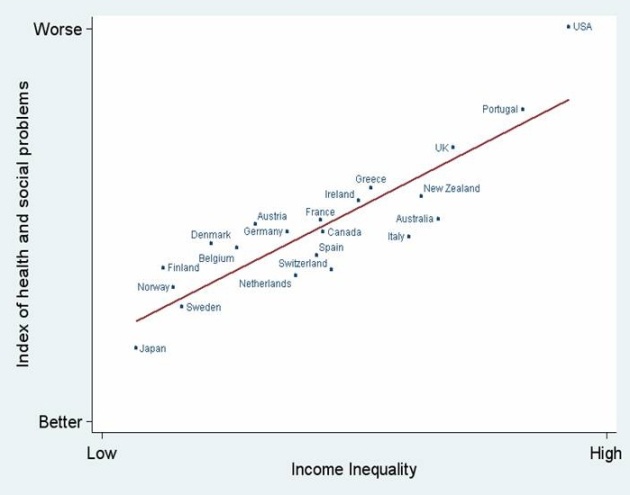
The negative consequences of extreme inequality have been very well documented by numerous studies in a variety of fields. Nations with high levels of inequality have poorer outcomes across a huge range of health and wellbeing measures, from teenage pregnancies to drug and alcohol problems.

Income inequality has a huge impact on health and wellbeing even among wealthy western nations. Graph from ‘The Spirit Level’.

Conservatives, by definition, tend to defend the status quo with respect to institutional structures. This means that if current structures are resulting in increased inequality then they are driven to dismiss or play down the importance of inequality. In fact, many conservatives consider inequality to be essential in order to provide incentives for hard work. However, there is only value in an incentive to climb the ladder if climbing the ladder is possible.

The reality is that the more unequal a country is, the lower equality of opportunity they tend to have. Equality of opportunity relies, to some extent, on a degree of equality of outcome. Parents in poverty cannot provide their children with the same opportunities that wealthy parents can no matter how intelligent, well intentioned or well informed they are. Similarly, children in poor communities will likely attend schools with poorer student outcomes and lower teaching standards than those in wealthy neighbourhoods.

When it comes to inequality, conservatives are trapped between conflicting articles of faith; small government and meritocracy. The data imply you cannot have both. Meritocracy requires considerable government intervention, particularly in education, health and welfare.

The policy leaders in this area are the Nordic nations of northern Europe and we would do well to pay more attention to their successes. Not only do these nations have relatively low levels of inequality, they have high income mobility and score very well on measures of life satisfaction and wellbeing. They achieve this through a complex web of legislation but it is underpinned by well-funded universal healthcare, education and welfare systems. The effect of these is to provide more than just a safety net but rather a baseline standard of living such that everyone can live a dignified life. This seems to me the very essence of a civilised society and is certainly within reach of all wealthy western nations.

We can see why Hockey and Abbott chose to remove references to inequality from their Intergenerational Report. Honest discussion of inequality reveals the incoherence of their broader social vision. When reduced to outcomes, the conservative political agenda of defending current structures and institutions manifests as simply protecting the interests of wealth and power at the expense of the rest. That’s all it ever has been – the rest is smoke and mirrors.

Posted in Australian politics, Inequality, Political philosophy | Tagged , , , , , | Leave a comment

The war on waged labour – The Monthly

This piece published today at The Monthly online.

The war on waged labour

Penalty rates are under threat. What is at stake?

Image by Vernon Chan (Flickr).

Despite being haunted by the spectre of WorkChoices, the campaign by the Coalition in support of business interests and against labour remains systematic and thorough.

Head over to The Monthly to read the full piece.

Posted in Australian politics, Inequality, political economy | Tagged , , , , , | Leave a comment

A sustainable budget surplus is beyond the government’s control, as Joe Hockey has come to realise

Originally published at The Guardian.

‘It’s Hockey’s promised constant federal budget surpluses that are unsustainable, not budget deficits. Photograph: Mike Bowers/Mike Bowers

Joe Hockey, the treasurer, now concedes he may not be able to deliver his promised budget surplus any time in the foreseeable future. This news is good for private savings because, when the government runs a surplus, the non-government sector must run a deficit.

This is a simple reality of macro-economic accounting. There are only so many Australian dollars. If the government taxes more than it spends (a surplus), it is taking more dollars out of the private sector than it is putting in. Assuming exports equal imports those dollars can come from only one place – private domestic savings. Everyone’s surplus is somebody else’s deficit.

Why almost nobody understands this or reports on it is something of a mystery. It’s an economic and accounting reality that has been talked about for many years by monetary economists such as Professor Bill Mitchell and his colleagues at the University of Newcastle.

The arithmetic is very simple. Total net financial assets in Australian dollars is the sum of government assets, plus net private domestic assets (individuals and businesses), plus net foreign assets. If the federal government runs a surplus then the money has to come from one of the other two. Given the government has virtually no control over the foreign component, a surplus will usually be accompanied by a reduction in savings in the domestic private sector (households and businesses) as they pay more in tax than the government is spending into the private economy.

When the federal government runs a surplus, private debt almost always increases. In other words, the banks create the money to fill the hole left by the government surplus. The much heralded surpluses of the Howard/Costello government were precisely matched by non-government deficits. These budget surpluses were partly supported by trade surpluses (foreign sector deficits) but even so, private debt increased dramatically.

Because there is a finite net number of Australian dollars in the private sector at any one time, total surpluses and deficits across all sectors of the economy must, by definition, sum to zero. The data, of course, support this conclusion. Data from Australian Bureau of Statistics via the University of Adelaide’s Steven Hail.

Hockey has stated that he wants to reach budget surplus and then remain there. The only way that this is sustainable is if we match the budget surplus with a trade surplus – if we export more than we import. Trade balances are largely beyond the government’s control, certainly in the short term. This means that the sustainability and stability of a budget surplus is also beyond the government’s control – as Hockey is belatedly coming to realise.
Advertisement

In the absence of a strong trade surplus, a government surplus can only be achieved by reducing private sector savings – either directly reducing actual savings or being funded by new debt. This is simply an accounting identity, it’s true by definition. There is nowhere else for the money to come from. Similarly, in order for the private sector to increase savings relative to the trade balance, the government must run a deficit. Again, there is nowhere else for that money to come from.

The implications of this simple accounting reality are profound indeed. Our entire national conversation about government finances is based on false premises. When Hockey says he wants a budget surplus, what he’s also saying is he wants to reduce private sector savings. Is that a good thing or a bad thing? At a time when private sector debt is heading up towards 200% of GDP, I’d be inclined to think decreasing private savings is a bad thing. Private sector debt is a much, much bigger potential problem in this country than public sector debt.

It’s Hockey’s promised constant federal budget surpluses that are unsustainable, not budget deficits. You cannot continually pull more money out of the private sector than you’re putting in without destroying the economy.

When the truth is the opposite of what we’re being told, it’s a good idea to examine who benefits. Privatising the deficit means big gains for lenders. Lending money to the public is far more profitable than owning government bonds. The financial sector are both the greatest beneficiaries of such policies and among the greatest donors to both the Coalition and Labor. Coincidence? Maybe.

Posted in Australian politics, Economic theory | Tagged , , , | 2 Comments

Reviewer for a FactCheck article in The Conversation

I reviewed the below FactCheck for the conversation. Unfortunately there is little space as a reviewer to say much but I would like to have gone into more detail discussing who really loses and who benefits from changes in company tax rates.

I’ve advocated in the past for a reduction in company tax rates but only as part of reforms that increase taxes on speculation and rent-seeking. I don’t think the overall tax burden should be reduced but I do think we could target it better so that we encourage productive economic activity that doesn’t damage the environment while discouraging speculation and other rent-seeking.

FactCheck: is Australia’s corporate tax rate not competitive with the rest of the region?

It is true that our “headline” (or statutory) corporate tax rate of 30% is higher than that of many other countries. (AAP Image/Dean Lewins)

By Kevin Davis, Australian Centre for Financial Studies

“Well, Jon, the Government’s about to bring in a 1.5% corporate, or company, tax cut from the 1st of July. That’s something that obviously we support, because (the) corporate tax rate at 30% is not competitive with the rest of the region and we need to drive that down.” – Innes Willox, Australian Industry Group Chief Executive, ABC Melbourne Radio with Jon Faine, February 3, 2015.

Mr Willox’s comment followed Prime Minister Tony Abbott’s National Press Club speech on February 2, where he promised “a small business company tax cut on July 1 – at least as big as the 1.5% already flagged.”

It is true that Australia’s “headline” (or statutory) corporate tax rate of 30% is higher than that of many other countries, particularly some like Hong Kong, Singapore and Ireland, which have used low tax rates to help attract international investment.

When asked by The Conversation for data to support Mr Willox’s statement, a spokesman for the Australian Industry Group referred to the Henry Tax Review, which found that:

“Relative to other similar size OECD countries, Australia’s company income tax rate is high.”

As the table below shows, Australia’s rate is above typical Asian and European rates in 2014, but not markedly out of line with the G7 countries (Canada, France, Germany, Italy, Japan, the United Kingdom, and the United States).

[The original article contains a figure comparing headline company tax rates but I could not reproduce it here for some reason.]

Apples and oranges

But, Australia’s dividend imputation tax system means that any comparison of our current 30% rate with statutory corporate tax rates elsewhere is like comparing apples and oranges.

Much of Australian company tax paid is rebated to shareholders, via the distribution of franked dividends and the attached tax credits are used by Australian shareholders to offset their income tax. The more tax paid by the company, the less to be paid by the investor.

Imputation tax systems are rare internationally, with Australia and New Zealand the main examples. In contrast, there is generally “double taxation” of dividends (full investor-level taxation of dividends paid out of after-tax company income) in classical tax systems common overseas, although some involve a lower personal tax rate on dividends versus wage income.

To illustrate the difference, let’s say we had $100 of Australian company income. Australian company tax is paid at 30% and the remaining $70 is paid to an Australian shareholder with tax imputations attached to them. For argument’s sake, let’s say that shareholder is also on a 30% income tax rate. That $70 of dividend income they just received would not be taxed again. The total government tax take is $30. For the same situation under a classical tax system, the investor would be levied a further $21 of income tax (30% of the shareholder’s $70 dividend), giving a total government tax take of $51.

So, in the case where the Australian company has only Australian shareholders to whom it distributes all after-tax income as franked dividends, the company tax is “washed out” via the tax credits distributed to the shareholders.

Reducing the company tax rate would simply mean the company in the example above distributes more cash but fewer franking credits to attach to the dividend. Less tax would be paid by Australian companies and more by Australian shareholders in the form of income tax.

If company tax rates were lowered, foreign companies would pay less tax and the shortfall in the government tax take would not be made up by income tax (because foreign firms cannot distribute franked dividends to shareholders).

Overall government tax revenue may decline because of less company tax paid by foreign companies and also where Australian companies retain earnings rather than paying them all out with franking credits attached.

Foreign investors want less company tax

Franking credits are of no value to foreign investors who would benefit if the company tax rate were lower. So foreign investors do look closely at how Australia’s corporate tax rate compares with other countries.

But foreign investors also consider non-tax issues, including government budgetary outcomes, when deciding where to invest.

Verdict

It is true the corporate tax rate at 30% is higher than some other countries in our region, but it is average compared to G7 countries. Further, Australia’s franked dividends system means Australian shareholders already enjoy favourable tax conditions on income earned from their investment in companies. However, foreign investors do not benefit from franked dividends and would benefit from a lower company tax rate in Australia.


Review

I agree with all of what has been said above but would add that Mr Willox’s statement conceals some value judgements.

As Kevin Davis has shown above, it is true our headline corporate tax rate of 30% is higher than that of our neighbours in the region. But given our system of dividend imputation, it is questionable at best to say that having a headline corporate tax rate higher than our neighbours makes us uncompetitive. Economic and political stability are big factors for businesses making investment decisions, as is available infrastructure, wage rates, other taxes, and the nature of the industry in question.

To Kevin’s analysis, I would also add that there is potential for a “race to the bottom”, where international competition drives company tax rates ever lower, resulting in ever dwindling government services for the population. – Warwick Smith

This article was originally published on The Conversation.
Read the original article.

Posted in Australian politics, tax economics | Tagged , , , | Leave a comment

Op-ed in The Australian that attacks my guardian article is incoherent

There are no laws in economics. Free market and small government ideology are trojan horses for plutocracy.

The below op-ed was published in last week’s Australian. It is critical of my piece in The Guardian the week before. I contemplated publishing a reply but after reading the piece properly there’s actually very little substance to reply to. I know it’s an opinion piece and there’s not a lot of space to mount a proper argument but it’s very puzzling to me that a professor of finance would bother to write such an empty piece and that The Australian would publish it (OK, perhaps not entirely surprising as ideology is a pretty obvious explanation for both events). Anyway, here is the piece in quote marks with my response interspersed. If you want to read the uninterrupted piece from The Aus then follow the link below.

Federal finances and family budgets have a great deal in common

 WHEN Finance Minister Mathias Cormann said earlier this month said that it was “unfair to rob our children and grandchildren of their opportunities to pay for today’s lifestyle”, he was attacked by economists from all sides of the political spectrum.

Warwick Smith wrote in The Guardian on January 9: “Repeat after me: the Australian economy is not like a household budget”, and said the Abbott government’s attempt to justify reining in budget deficits on these grounds is one of the “great myths of modern government financing”.

My friend and unreconstructed Keynesian economist Geoff Harcourt accuses the government, on the website The Conversation, of “deficit size fetishism” and denies the “supposed link between (deficits) and the welfare of future generations”.

My colleague Richard Holden denied in The Weekend Australian on January 10 denied that the national economy is like a household and said it was “misguided” to think that governments, like families, must live within their means.

The government’s difficult task is not helped by economists who believe that any restraint advocated by governments of a persuasion they may not like is pure ideology and that the clear and obvious analogy with household and family budgets has no relevance.

I think this last paragraph is something of a straw-man as it doesn’t accurately represent the content of the articles in question. In my case, what I argued was that inflation should be used as the constraint for government spending instead of taxes and borrowing and that comparisons with households are irrelevant. This is different from arguing that restraint by the Coalition is ideological (I think it is but that is actually a separate matter). As best I can tell all Australian politicians make use of these false analogies.

I suspect the need to begin this piece with a straw-man reveals the entire story behind this op-ed: the author has no argument to make but simply doesn’t like the conclusion reached by the economists (including myself) he cites and misrepresents.

There is a very important insight contained in the above exchange between Professor Swan and I. Economic policy is fundamentally about the translation of values. This is not science, it’s philosophy. Your economic policy is going to depend on the kind of society you want. The economic policy – indeed the very economic system – follows on from decisions about values.

Popular radio personality Alan Jones tells his listeners that governments are subject to the same laws of economics, same resource scarcity, and same need not to waste the taxpayer’s scarce dollar as the families whose tax payments make government possible.

Have he and his listeners been conned, if not Cormanned?

Yes they have. There are no “laws of economics”. Economics is not a natural science like physics. Our economic system is a construct and nowhere is this more obvious that in monetary economics. To think that there are somehow laws of economics is to have fallen victim to the greatest con of our age. We constructed the economic system and we can reconstruct it if it’s not working for us.

Smith, a research economist, is convinced Jones and his listeners are wrong because “the federal government can create money”. Certainly, some governments have tried to pay their debts by printing money; Zimbabwe’s Robert Mugabe comes to mind.

So, first the logical fallacy of the straw-man is used. Next the logical fallacy of guilt by association. Zimbabwe is the economics equivalent of Hitler and the Nazis – you know the drill, mention somebody or some policy and Hitler in the same sentence and you make them look bad by association. “Does Peter not realise that Hitler was elected and therefore democracy is a flawed political system?”

Professor Swan is making exactly this kind of empty attack by invoking Zimbabwe in a discussion of money creation. What he fails to mention is that first Mugabe destroyed Zimbabwe’s productive capacity and then tried to print the country’s way out of economic trouble. Last I noticed Australia still had productive capacity and the point of my article was that you can create money when there is spare productive capacity i.e. in conditions precisely the opposite of those that existed in Zimbabwe. I don’t know if Professor Swan understands this but chose not to say it because it undermined his argument or if he doesn’t understand it. Neither paints a very flattering picture of his op-ed.

But so can individuals. Every household and family has a perfect legal right to create its own exclusive fiat money, Peter Swan banknotes.

In this sense, you and I are no different to Zimbabwe and Mugabe. My currency and his are rightly rejected as worthless, forcing Zimbabwe to use US dollar denominated currency, as does, effectively, Hong Kong.

The federal government does differ from you and me in one respect, though: it can and does pass laws making Australian banknotes legal tender.

Thus domestic households have to accept Australian dollar denominated currency and if they purchase federal government debt denominated in Australian dollars they take the risk of its value being eroded by Australian governments when they create inflation.

Is it only me who finds this pretty amusing? What Professor Swan is effectively saying here is that individuals and households are exactly the same as the federal government except in a few critical ways that make them completely different. He also fails to mention one other fundamentally important difference which is that individuals and companies in Australia are required to pay tax in Australian dollars.

The consequences of these differences between households and the federal government are profound. Again, it’s wild that Professor Swan would glibly state this fundamental difference between households and government as if it’s inconsequential. It’s true that I can create my own currency but I cannot force anybody to use it nor force anybody to pay me using it. The federal government can do these things and the flow on consequences are as fundamental to our financial system as energy is to our real economy.

Australians holding our wartime debt whose wealth was severely depleted by the inflation that occurred during the Korean War-inspired wool boom in the early 1950s experienced this.

Professor Swan now makes a huge and unjustified leap to start discussing the negative consequences of inflation. There are two possibilities here: he either didn’t read my article or he’s deliberately distorting it in order to make his argument. The whole focus of my piece was on using inflation as the guide and limit to government expenditure. If inflation is the primary focus then why would he expect there to be high inflation? The only way inflation would be a problem under a system which specifically focusses on inflation is incompetence. The idea is to use both monetary and fiscal policy working together using economic capacity and inflation as their guiding measures.

Australia is a massive capital importing nation depending almost entirely on foreign rather than domestic savings to fund federal government deficits. These lenders are sufficiently sophisticated not to fall into the domestic inflation trap. So much of the borrowing is denominated in American or other global currencies, putting the federal government on a similar basis to the states. Queensland has already lost its AAA credit rating crown. Unless the federal government can balance the budget and pay down debt, it risks following suit.

This is simply false. Virtually all Australian government debt is denominated in Australian dollars. In Professor Swan’s defence, prior to the 1980’s what he said was true. Perhaps he needs to update his figures.

Printing money simply devalues the Australian dollar, magnifying both the interest and the principal repayment burden.

Even for an op-ed this is mind-boggling in its lack of nuance. How much has the creation of trillions of dollars in the US during quantitative easing devalued the US dollar? How much inflation has it caused? What’s the interest and principal repayment impact? I’ll give you a clue – virtually no impact on any of these things at all. Yes, printing money when there is no spare capacity in the economy has negative consequences. Hint – don’t do it then, do it when there’s the capacity to absorb it. It’s not that hard.

Harcourt, however, believes it is a fallacy that the federal government needs to balance its budget over the economic cycle. Nor does he believe there is a problem with internal debt as it postpones the need for higher taxes, resulting only in the payment of more interest to Australian lenders.

This he regards as a transfer even though taxpayers and lenders need not be one and the same.

Harcourt believes there may be a case for foreign borrowing to pay for social infrastructure, even though he admits that higher exports will be required to repay the debt. However, this leaves us paying a rising international interest bill just to meet budget outlays into the indefinite future.

Holden argues that the analogy with household budgets is inappropriate because unlike mere mortals, governments live forever. He thinks that families “pay down that debt through prudent spending” only because they want to leave something to their children.

This does not obviate the need for governments to repay debt to prevent the interest burden paid by future generations blowing out beyond their diminishing capacity to pay, with the end of the baby boom generation, the ageing of the population, and collapse in our terms of trade. Holden points out that “government doesn’t make stuff and it doesn’t create jobs or wealth”. I agree with this pro-market, anti-Keynesian sentiment. With properly enforced property rights in place the private sector can be left to provide social infrastructure such as hospitals and, presumably, toll roads.

As I’ve argued elsewhere, the whole government debt burdening future generations thing is just another myth. Future generations standard of living will not be burdened or restricted by our debt. Their standard of living will be restricted by the goods and services they produce. As Warren Mosler says, you can’t send goods and services back in time to pay for past expenditure. You only have to think outside the household analogy to realise that what Professor Swan says here is illogical. Only if people like him hold sway on governments will today’s debt impact on future generation’s standard of living because they will impose mindless austerity policies on future generations in order to achieve their aims of privatising and financialising our entire lives.

There is a cost of governments overspending today and that cost is inflation today. This is why inflation is the best constraint on government expenditure. It seems this point entirely escaped Professor Swan. As Upton Sinclair said “It is difficult to get a man to understand something, when his salary depends on his not understanding it.” Similarly it is difficult to get somebody to understand something if it undermines their entire career’s work. Professor Swan’s resistance is understandable in this context. However, as physicist Max Planck put it “[a] new scientific truth does not triumph by convincing its opponents and making them see the light, but rather because its opponents eventually die, and a new generation grows up that is familiar with it.” These are not scientific truths that we are discussing but they are the realities of modern finance as we have constructed it.

The federal government does not need to incur ever-rising deficits and debt to provide law and order and enforce property rights. Hence Holden’s arguments seem to indicate a close analogy ­between government and household debt.

Finally we get to the substance of this article. Professor Swan is a small government, free-market advocate. At the very extreme end of this spectrum are those who think the role of government should be restricted to law enforcement, national security and the enforcement of property rights. It’s code for handing all the power in society over to the rich. There is no equal opportunity in a laissez-faire economy. If you’re born wealthy you will very likely succeed and if you’re not you won’t. It seems that’s the Australia that Professor Swan wants. Unfortunately for him he’s completely out of step with the overwhelming majority of Australians who see the government’s role as much greater than that.

Both must be prudently managed and debt levels kept in check so as not to destroy the bequest motive (households) and to prevent interest payments alone absorbing the limited capacity to raise revenue (governments).

None of these three advocates for essentially unlimited public debt has in my estimation made the case, or even shown how it is possible, without a breakdown of society. The bailout crisis in Greece is a case in point. The analogy between government and household budgets remains intact.

Peter Swan is professor of finance in the school of banking and finance, UNSW Business School.

This last paragraph is like the Zimbabwe fallacy but an even worse attempt at guilt by association. It demonstrates once again that Professor Swan is trapped in a pre 1970s framework. The post Bretton Woods financial world is radically different from that under Bretton Woods between WWII and 1971. That Professor Swan would use Greece as a warning for Australia shows us that he doesn’t understand the post Bretton Woods era. Because Greece does not have the capacity to create its own currency it is out of options. The Euro cannot save Greece. If Greece still had its own currency it would have a raft of options for escaping its current problems including money creation for economic stimulus. There is plenty of spare capacity in the Greek economy to absorb money creation without causing inflation – no Professor Swan, Greece is not comparable to Zimbabwe.

It’s taken a lot of words to show it but the op-ed in The Australian contained no coherent argument against my Guardian article or the others cited by Professor Swan. Ultimately he reveals his motivation in the third last paragraph where he advocates for a system that hands virtually all power in society to the wealthy. In other words, Professor Swan advocates for a plutocracy in the guise of a small government, free market economy. That’s not what I want and, happily, it’s not what the overwhelming majority of Australians want. It’s important that we watch out for trojan horses like those that Professor Swan and the editors of The Australian offer us.

Warwick Smith

Posted in Economic theory, Op-ed, philosophy of economics | Tagged , , , , , | 1 Comment